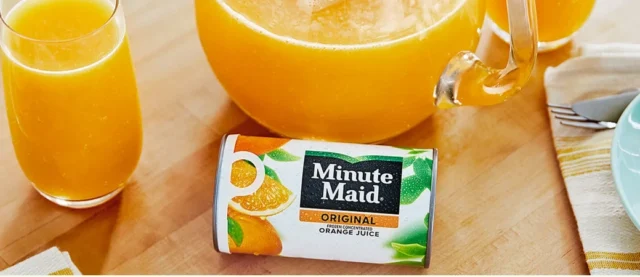
The End of an Era: Minute Maid Bids Farewell to the Frozen Can
For generations of Americans, the sound of a frozen cylinder of orange juice sliding into a plastic pitcher was the definitive soundtrack to breakfast. However, that era is officially coming to a close. Coca-Cola, the parent company of Minute Maid, has announced it is discontinuing its iconic line of frozen canned juice concentrates in North America, marking the end of an 80-year retail legacy.
The decision, first reported by industry outlets such as Food Dive, signals a major shift in how modern consumers approach the most important meal of the day. In a statement provided to Food Dive, a Coca-Cola spokesperson explained the rationale behind the departure: “With the juice category growing strongly, we’re focusing on products that better match what our consumers want.” The company confirmed that the phase-out will take place during the first quarter of 2026, with existing store inventory remaining available only until supplies last.
The history of Minute Maid is deeply intertwined with the evolution of the American food industry. The product originated in 1945 as a response to a U.S. Army contract for powdered orange juice to nourish soldiers. While the war ended before the powder could be shipped, the technology paved the way for the world’s first frozen concentrated orange juice. By the 1950s and 60s, Minute Maid had become a household staple, praised for its convenience and long shelf life compared to fresh-squeezed alternatives.
Despite its storied past, the “frozen-from-concentrate” category has faced a steep uphill battle over the last two decades. As Food Dive notes, advances in pasteurization and distribution technologies eventually gave rise to the “ready-to-drink” (RTD) carton, which eliminated the need to thaw and mix. By the mid-2010s, demand for frozen concentrates had plummeted, accounting for a mere 7% of the total orange juice market. Today’s shoppers increasingly prioritize “functional” beverages—those with added vitamins or reduced sugar—and the sheer convenience of grab-and-go packaging.

The discontinuation affects the entire frozen lineup, including classic orange juice, lemonade, limeade, pink lemonade, and raspberry lemonade. It also includes sister brands like Fruitopia and Five Alive in certain markets. While nostalgic fans have taken to social media to mourn the loss of a “childhood staple,” the data suggests that most consumers have already moved on. According to NielsenIQ data cited by industry analysts, sales of frozen beverages fell nearly 8% in the last year alone.
As Coca-Cola pivots its strategy, it is doubling down on its refrigerated offerings and sugar-free varieties, which have seen significant growth in market share. While the “ker-plunk” of the frozen concentrate may be disappearing from the freezer aisle, Minute Maid remains a dominant force in the juice world—just in a format that fits the fast-paced, convenience-focused lifestyle of the 21st century. For those who still crave the old-school slushy experience, the clock is ticking to grab those last few cans.
Source: Food Dive
Disclaimer
Artificial Intelligence Disclosure & Legal Disclaimer
AI Content Policy.
To provide our readers with timely and comprehensive coverage, South Florida Reporter uses artificial intelligence (AI) to assist in producing certain articles and visual content.
Articles: AI may be used to assist in research, structural drafting, or data analysis. All AI-assisted text is reviewed and edited by our team to ensure accuracy and adherence to our editorial standards.
Images: Any imagery generated or significantly altered by AI is clearly marked with a disclaimer or watermark to distinguish it from traditional photography or editorial illustrations.
General Disclaimer
The information contained in South Florida Reporter is for general information purposes only.
South Florida Reporter assumes no responsibility for errors or omissions in the contents of the Service. In no event shall South Florida Reporter be liable for any special, direct, indirect, consequential, or incidental damages or any damages whatsoever, whether in an action of contract, negligence or other tort, arising out of or in connection with the use of the Service or the contents of the Service.
The Company reserves the right to make additions, deletions, or modifications to the contents of the Service at any time without prior notice. The Company does not warrant that the Service is free of viruses or other harmful components.