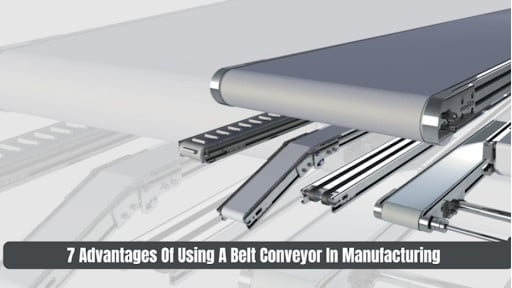
In the world of manufacturing, efficiency doesn’t depend on machines. It is the smoothness of material movement from one stage of production to the next.
That said, when material handling slows, well-planned operations begin to lose momentum. Delays are on the rise, manual work is increasing, and safety risks are gradually increasing. That’s why manufacturers pay serious attention to systems that help keep workflows steady and predictable.
Considering this, belt conveyors have become a reliable solution for handling such movement. They facilitate continuous material transport, reduce physical stress on workers, and help maintain order across busy production floors. Moreover, their simplicity and flexibility make them ideal for many types of manufacturing environments.
The most significant advantages of using a belt conveyor in the manufacturing industry are covered below, along with how each is essential to productivity, security, and long-term operational control.

- Continuous and Uninterrupted Material Flow
One of the most powerful benefits of using a belt conveyor in a manufacturing company is that it can move materials continuously. Unlike forklifts or manual transport, conveyors don’t use stop-start cycles. Materials are moved at a controlled rate from one workstation to the next.
This consistency helps prevent bottlenecks, especially in assembly-based environments where timing is important. When materials are sent on time to each station, overall output is more predictable and easier to manage.
- Lower Labor Dependency and Physical Strain
Manual material handling is time-consuming and physically demanding. Thus, belt conveyors are used to automate repetitive transport jobs to minimize the need for workers to carry or push heavy loads around the floor.
This not only reduces labor costs in the long run but also helps to reduce fatigue and injuries. Occupational safety studies have shown that minimizing manual lifting can greatly reduce musculoskeletal disorders in industrial environments, resulting in a healthier workforce in the long run.
- Improved Workplace Safety
Safety is always a priority on manufacturing floors. Loose materials, heavy loads, and frequent movement also lead to an increased risk of accidents.
Belt conveyors help to keep materials contained and on defined paths.
With the right guarding and speed controls, conveyors minimize the risk of collisions while eliminating the need for workers to walk long distances carrying loads. Safety research in industry has repeatedly shown that automated material handling systems are associated with fewer workplace incidents than manual methods.
- Adaptable to Different Production Layouts
Manufacturing facilities are hardly ever static. Changes in equipment are made, new processes are introduced, and layouts change.
Belt conveyors can be very flexible, making them suitable for flexible conveyor systems that accommodate straight paths, curves, manifolds, and declines. This flexibility makes it possible for manufacturers to design systems based on existing infrastructure, rather than being forced to redesign entire floors.
Furthermore, modular conveyor designs make systems easier to expand or reconfigure as needed for production changes.
- Scalable for Growing Production Needs
As production volumes rise, material handling is often a limiting factor. Belt conveyors are a scalable solution that can expand as operations grow. Additional sections of the conveyor can then be added without replacing the entire system.
This makes them ideal for manufacturers seeking long-term expansion plans. Instead of spending over and over again on new handling solutions, companies can add to their existing conveyor setup as the demand for that product grows.
- Energy Efficiency and Cost Control
Modern belt conveyor systems are made to work efficiently. Low-friction belts, optimized motors, and variable speed controls help save energy as compared to traditional transport methods, such as forklifts.
Many systems also allow adjusting speed based on workload, avoiding unnecessary energy use during slow periods. Over time, this results in reduced operating costs and promotes sustainability objectives. Industry analyses of conveyor energy efficiency show that optimized systems reduce overall power consumption in manufacturing environments.
- Better Product Handling and Quality Control
Consistent handling is critical to maintaining product quality. Belt conveyors tend to move items smoothly, minimizing the risk of damage from drops or rough handling.
They also integrate well with inspection devices such as scanners and sensors, as well as weighing devices. This means that manufacturers can conduct quality checks during transport, rather than after, and help to identify defects earlier and avoid waste. Many modern production facilities depend on conveyor-based inspection systems to maintain quality standards.
Conclusion
Belt conveyors remain important in modern manufacturing because they solve everyday operational challenges without causing additional complexity. From keeping material flowing uninterrupted to improving safety to reducing labor strain to supporting scalable growth, the benefits of them span the entire production cycle.
If properly designed and implemented, these systems can be seamlessly integrated into manufacturing workflows and provide consistent performance over time. By now, you are clear on the details of how belt conveyors improve efficiency, enhance workplace safety, and enhance material handling in manufacturing operations.
Disclaimer
Artificial Intelligence Disclosure & Legal Disclaimer
AI Content Policy.
To provide our readers with timely and comprehensive coverage, South Florida Reporter uses artificial intelligence (AI) to assist in producing certain articles and visual content.
Articles: AI may be used to assist in research, structural drafting, or data analysis. All AI-assisted text is reviewed and edited by our team to ensure accuracy and adherence to our editorial standards.
Images: Any imagery generated or significantly altered by AI is clearly marked with a disclaimer or watermark to distinguish it from traditional photography or editorial illustrations.
General Disclaimer
The information contained in South Florida Reporter is for general information purposes only.
South Florida Reporter assumes no responsibility for errors or omissions in the contents of the Service. In no event shall South Florida Reporter be liable for any special, direct, indirect, consequential, or incidental damages or any damages whatsoever, whether in an action of contract, negligence or other tort, arising out of or in connection with the use of the Service or the contents of the Service.
The Company reserves the right to make additions, deletions, or modifications to the contents of the Service at any time without prior notice. The Company does not warrant that the Service is free of viruses or other harmful components.