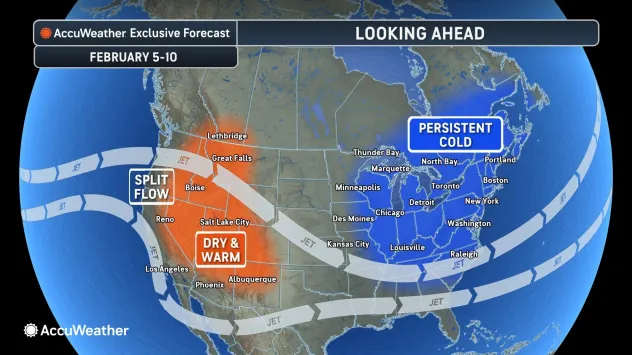
As the calendar turns to February 2026, the eastern half of the United States is bracing for a sustained period of bitter winter weather. According to AccuWeather meteorologists, a significant disruption of the polar vortex is the primary culprit behind a weather pattern that will lock in freezing temperatures and heighten the risk of major snowstorms for millions of Americans through much of the month.

The polar vortex—a massive, rotating expanse of cold air that typically remains confined to the Arctic by the polar jet stream—has undergone a “collapse” or major split. When the vortex is strong, it acts as a wall, keeping the coldest air on Earth bottled up at the pole. However, recent stratospheric warming events have weakened this “wall of wind,” allowing massive lobes of Arctic air to break free and spill southward into North America.
“The polar vortex has weakened and is in the process of splitting,” explained AccuWeather Lead Long-Range Meteorologist Paul Pastelok. He noted that this configuration promotes a “meridional” flow, effectively opening the floodgates for frigid air to travel directly from the Arctic into the central and eastern United States. This atmospheric shift is expected to persist, keeping the region in a deep freeze long after the initial January surges.

For residents from the Midwest to the Atlantic Seaboard, the forecast is stark. AccuWeather experts warn that temperatures could drop by 30 to 40 degrees Fahrenheit below historical averages during the most intense surges. Cities such as Detroit, New York, and Boston are already experiencing some of their coldest winter conditions in nearly a decade. Even the Deep South and Florida will not be immune, as the southward lunge of the jet stream pushes the freezing line toward the Gulf Coast.
The impact of this pattern extends beyond just the thermometer. AccuWeather meteorologists are closely monitoring the potential for “blockbuster” winter storms. The combination of Arctic air pushing south and a persistent storm track along the Gulf and East coasts creates a volatile environment. “The ongoing active storm track in the southern U.S. will help to pull the colder air through the Midwest and into the East in the wake of the storms,” Pastelok added. This setup increases the likelihood of major nor’easters that can paralyze the I-95 corridor with heavy snow and ice.
Furthermore, the lack of ice cover on the Great Lakes early this season is expected to exacerbate the situation. “Following a mild start to the winter season, lake ice coverage is currently low,” said AccuWeather Meteorologist Adam Sadvary. This allows the cold Arctic air to pick up more moisture from the open water, leading to frequent and intense bands of lake-effect snow and dangerous snow squalls that can strike with little warning.
The duration of this frigid pattern is particularly concerning for energy grids and public safety. Unlike a brief “cold snap,” this locked-in pattern means that heating demands will remain at peak levels for weeks. AccuWeather analysts estimate that the prolonged cold could lead to billions of dollars in economic losses due to infrastructure strain, property damage from frozen pipes, and travel disruptions.
Safety remains a top priority as the coldest air of the season settles in. AccuWeather Senior Meteorologist Brett Anderson warned that the extreme temperature departures could be “painful” and dangerous for anyone outdoors. RealFeel® Temperatures are expected to plummet well below zero in the Appalachians and into the single digits along the coast during the height of the outbreaks.
While there may be brief periods of moderation in which temperatures rise toward seasonal norms, the overall signal for February remains one of persistent cold. The AccuWeather long-range team emphasizes that the polar vortex disruption is a “major shift” that won’t be easily reversed. Residents are advised to maintain full heating-fuel tanks, keep snow-removal equipment ready, and prepare for a month that will likely be remembered as the heart of a truly punishing winter. As the polar vortex continues to wobble and discharge its frozen cargo, the Eastern U.S. remains at the mercy of the Arctic’s most potent air.
Source: AccuWeather
Disclaimer
Artificial Intelligence Disclosure & Legal Disclaimer
AI Content Policy.
To provide our readers with timely and comprehensive coverage, South Florida Reporter uses artificial intelligence (AI) to assist in producing certain articles and visual content.
Articles: AI may be used to assist in research, structural drafting, or data analysis. All AI-assisted text is reviewed and edited by our team to ensure accuracy and adherence to our editorial standards.
Images: Any imagery generated or significantly altered by AI is clearly marked with a disclaimer or watermark to distinguish it from traditional photography or editorial illustrations.
General Disclaimer
The information contained in South Florida Reporter is for general information purposes only.
South Florida Reporter assumes no responsibility for errors or omissions in the contents of the Service. In no event shall South Florida Reporter be liable for any special, direct, indirect, consequential, or incidental damages or any damages whatsoever, whether in an action of contract, negligence or other tort, arising out of or in connection with the use of the Service or the contents of the Service.
The Company reserves the right to make additions, deletions, or modifications to the contents of the Service at any time without prior notice. The Company does not warrant that the Service is free of viruses or other harmful components.