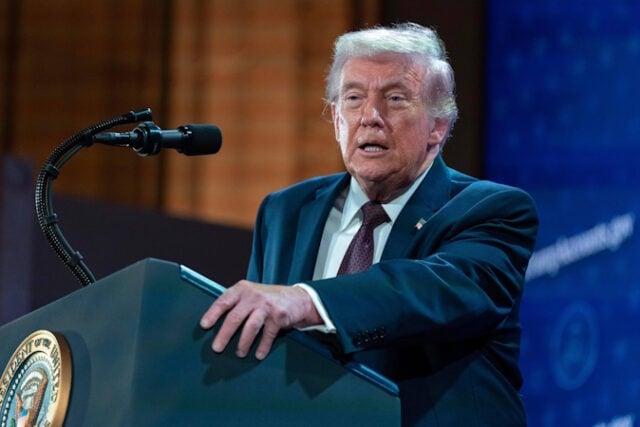
WASHINGTON, D.C. — In a move that has sent shockwaves through the American legal and political landscape, President Donald Trump has called for the “nationalization” of the United States election system. Speaking on The Dan Bongino Show on February 2, 2026, the President argued that the Republican Party must move to “take over” the voting process from state authorities, citing what he described as pervasive “corruption” in local election management.
The President’s remarks represent his most explicit endorsement to date of a federal takeover of the electoral process—a power traditionally reserved for the states under the U.S. Constitution.
“The Republicans should say, ‘We want to take over. We should take over the voting in at least many—15 places,'” Trump said during the interview. “The Republicans ought to nationalize the voting. We have states that are so crooked.”
A Shift Toward Federal Command
While the President did not specify which “15 places” he intended to target, his comments come amid an escalating campaign by his administration to exert federal influence over election administration. The call for nationalization follows the FBI’s recent seizure of 2020 election ballots and records from Fulton County, Georgia—an action widely seen as a precursor to more aggressive federal intervention in the upcoming 2026 midterm elections.

For over a century, the “Times, Places and Manner” of holding elections have been primarily the domain of state legislatures. However, the Trump administration has increasingly utilized executive orders and Department of Justice (DOJ) litigation to challenge this status quo.
In March 2025, the President issued Executive Order 14248, titled “Preserving and Protecting the Integrity of American Elections.” That order mandated:
- Proof of Citizenship: Requiring the Election Assistance Commission (EAC) to include documentary proof of U.S. citizenship on national mail voter registration forms.
- Mail-In Ballot Restrictions: Directing the Attorney General to enforce a “receipt-by-Election-Day” rule, effectively attempting to invalidate state laws that count ballots postmarked by, but arriving after, Election Day.
- Voting Machine Decertification: Instructing the EAC to “rescind all previous certifications” of voting equipment, a move critics say could leave states without usable machines for the 2026 cycle.
Legal and Constitutional Blowback
Constitutional scholars and voting rights advocates have quickly condemned the President’s call for nationalization as an unlawful “power grab.”
“Under the Elections Clause of Article I and the Electors Clause of Article II, states—not the President—have the primary authority to run elections,” said Wendy Weiser of the Brennan Center for Justice. “There is no constitutional mechanism that allows a President to ‘nationalize’ voting or ‘take over’ local jurisdictions because he dislikes the results or the officials in charge.”
The administration’s efforts have already met resistance in the courts. Federal judges have recently blocked DOJ attempts to seize voter rolls in states like California and Minnesota. In those cases, judges ruled that the federal government does not have the authority to centralize the private information of millions of Americans within the executive branch without a clear mandate from Congress.
The Political Context
The President’s rhetoric has intensified as the 2026 midterms approach. Following a series of Democratic victories in the 2025 off-year elections—most notably in Virginia—Trump has framed the “nationalization” of elections as a defensive necessity for the GOP.
Critics argue that the administration is laying the groundwork to contest future losses. “This isn’t about election integrity; it’s about building a federal apparatus that can interfere with the results in real-time,” claimed a spokesperson for Fair Fight.
Conversely, supporters of the President’s plan argue that a uniform federal standard is necessary to prevent fraud. “President Trump is simply saying that we cannot have a patchwork of rules where some states ignore the law,” said a White House official. “Nationalizing certain standards ensures that every legal vote counts equally.”
As the debate intensifies, the administration appears poised to continue its pressure. With the DOJ already suing two dozen states for voter data and the FBI conducting raids on local election hubs, the call to “nationalize the voting” marks a new, more aggressive phase in the battle over the future of American democracy.
Sources and Links
- Bloomberg Government: Trump Says Republicans Should Federalize State Voting Rules
- Democracy Docket: Trump: ‘We should take over the voting’
- The White House (Archived/Current): Executive Order 14248: Preserving and Protecting the Integrity of American Elections
- Brennan Center for Justice: The President’s Executive Order on Elections Explained
- Mother Jones: Trump Goes Public With Plan to “Take Over” Elections
- Congress.gov (CRS): Executive Order on Elections: Legal Background and Court Challenges
Disclaimer
Artificial Intelligence Disclosure & Legal Disclaimer
AI Content Policy.
To provide our readers with timely and comprehensive coverage, South Florida Reporter uses artificial intelligence (AI) to assist in producing certain articles and visual content.
Articles: AI may be used to assist in research, structural drafting, or data analysis. All AI-assisted text is reviewed and edited by our team to ensure accuracy and adherence to our editorial standards.
Images: Any imagery generated or significantly altered by AI is clearly marked with a disclaimer or watermark to distinguish it from traditional photography or editorial illustrations.
General Disclaimer
The information contained in South Florida Reporter is for general information purposes only.
South Florida Reporter assumes no responsibility for errors or omissions in the contents of the Service. In no event shall South Florida Reporter be liable for any special, direct, indirect, consequential, or incidental damages or any damages whatsoever, whether in an action of contract, negligence or other tort, arising out of or in connection with the use of the Service or the contents of the Service.
The Company reserves the right to make additions, deletions, or modifications to the contents of the Service at any time without prior notice. The Company does not warrant that the Service is free of viruses or other harmful components.