As the sun sets this Sunday evening, February 1, 2026, the global financial landscape looks fundamentally altered. What began as a volatile week has culminated in a “Sunday Slump” for traditional commodities and cryptocurrencies alike. While families across the country enjoy their weekend leisure, institutional algorithms and panicked retail traders have spent the last 48 hours dumping gold, silver, and Bitcoin in favor of a singular, high-octane bet: Artificial Intelligence.
The exodus from metals and crypto represents a historic shift in the “fear vs. productivity” trade. For decades, investors fled to gold when the dollar looked weak; today, they are fleeing to the chips that power the future.
The Weekend Wipeout: Bitcoin and Metals in Retreat
The most startling activity occurred in the early hours of Sunday morning. Bitcoin ($BTC$), which had been struggling to maintain its footing above the psychological $80,000 mark, suffered a flash crash that saw it bottom out near $77,000. Although it has made a tepid recovery to approximately $78,600 by Sunday evening, the damage to the “digital gold” narrative is extensive. Over $1.6 billion in crypto bets were wiped out in a single liquidation wave as investors fled toward the perceived productivity of the tech sector.
The carnage was not limited to the digital realm. Gold and Silver—the bedrock of traditional wealth preservation—experienced their most violent movements in decades. Following the Friday nomination of Kevin Warsh as the next Federal Reserve Chair, gold prices plummeted more than 12%, sinking below the $5,000 per ounce threshold. Silver fared even worse, enduring a staggering 30% crash on Friday that saw prices dive toward $79 per ounce.

“We are witnessing a multidimensional polarization,” noted a senior strategist at J.P. Morgan. “The market is splitting into two worlds: AI and non-AI. Right now, the non-AI world—commodities and old-school hedges—is being treated as a source of cash to fund the AI land grab.”
The “Warsh Effect”: Why Safe Havens are Melting
The primary catalyst for this weekend’s sell-off is the “Warsh Effect.” U.S. President Donald Trump’s nomination of Kevin Warsh—a figure seen as a “hawkish” and stabilizing force—has fundamentally recalibrated expectations for the U.S. dollar. For months, gold and silver soared on fears of “dollar debasement” and a potential loss of Federal Reserve independence. The Warsh nomination has signaled to the markets that the Fed will likely remain a serious, independent institution committed to a strong dollar.
As the dollar index ($DXY$) surged over the weekend, the “inverse correlation” trade kicked in with a vengeance. Because gold and silver are priced in dollars, a stronger greenback makes them more expensive for global buyers, leading to massive sell orders. Furthermore, Warsh’s history of favoring tighter monetary policy suggests that real interest rates may stay higher for longer, increasing the “opportunity cost” of holding non-yielding assets like gold.
NVIDIA: The New Standard of Value
At the heart of this capital migration is NVIDIA ($NVDA$). As of the close of last week’s trading, NVIDIA’s market capitalization remains a titan at $4.6 trillion. While Bitcoin and Gold holders face “extreme fear” sentiment (currently 18/100 on the Fear & Greed Index), NVIDIA investors are looking toward a 2026 fiscal year, when analysts expect revenue growth of 60% to 63%.
The release of NVIDIA’s Rubin platform, slated for full production in the second half of 2026, has become the new North Star for global capital. Investors are no longer asking if gold will protect them from inflation; they are asking if they have enough GPU exposure to survive the AI-driven “supercycle.” This Sunday, the talk of the town isn’t the price of bullion, but rather the projections that AI spending will top $2.5 trillion this year. NVIDIA, with its annual chip update cycle, has effectively replaced gold as the world’s most trusted “hard asset”—not because it is scarce, but because it is the essential engine of global GDP.
The “Sunday Dump” and the Path Ahead
Sunday’s market activity suggests that the “four-year cycle” for Bitcoin may finally be broken, not by regulation, but by the sheer gravitational pull of AI. While gold and silver have traditionally benefited from geopolitical tensions—such as ongoing discussions about U.S. security deals and trade wars—the market is now betting that AI-driven productivity will “outgrow” these risks.
The “Sunday Dump” was exacerbated by technical triggers. On Friday, the CME changed margin rules for silver and gold contracts, forcing many leveraged traders to liquidate their positions over the weekend. Meanwhile, in China, a major commodity exchange closed leveraged trading, creating a domino effect that hit Western markets on Sunday evening.
Critics like Michael Saylor and Peter Schiff have spent the weekend in a heated digital debate. While Schiff warns that gold is “down but not out” due to soaring G7 debt, the price action tells a different story. With NVIDIA’s stock projected by firms like Bernstein and Evercore to reach targets as high as $352 by year-end, the allure of a shiny metal sitting in a vault is fading fast.
The Shift in Institutional Sentiment
Institutional demand, once the backbone of the 2025 gold rally, is pivoting. Data shows that over $2.7 billion has exited U.S. spot Bitcoin ETFs since mid-January. This liquidity isn’t going into cash; it’s flowing into the “AI Triple Threat”: NVIDIA, AMD, and the hyperscalers like Microsoft and Meta that are building the data centers of tomorrow.
“If you have $5,000 to invest this Sunday,” says one wealth manager from Charlotte, NC, “the consensus has shifted. A year ago, that bought you safety in an ounce of gold. Today, it buys you a stake in the infrastructure of the next century. The market has decided that chips are more precious than coins.”
Looking Toward Monday’s Open
As we look toward the Monday morning bell, the question is whether the $77,000 floor for Bitcoin and the $4,800 floor for gold will hold. Analysts at InstaForex suggest that while a “relief rally” is possible, the fundamental trend is clear. The era of low inflation and seamless globalization is over, replaced by a “fragmented” world where AI-driven efficiency is the only way to maintain profit margins.
For investors worldwide, this Sunday serves as a stark reminder: the “safe haven” of yesterday may be the “laggard” of tomorrow. In the race between the “Old Guard” (Gold/Silver), the “Rebel” (Bitcoin), and the “Innovator” (NVIDIA/AI), the innovator currently holds all the cards.
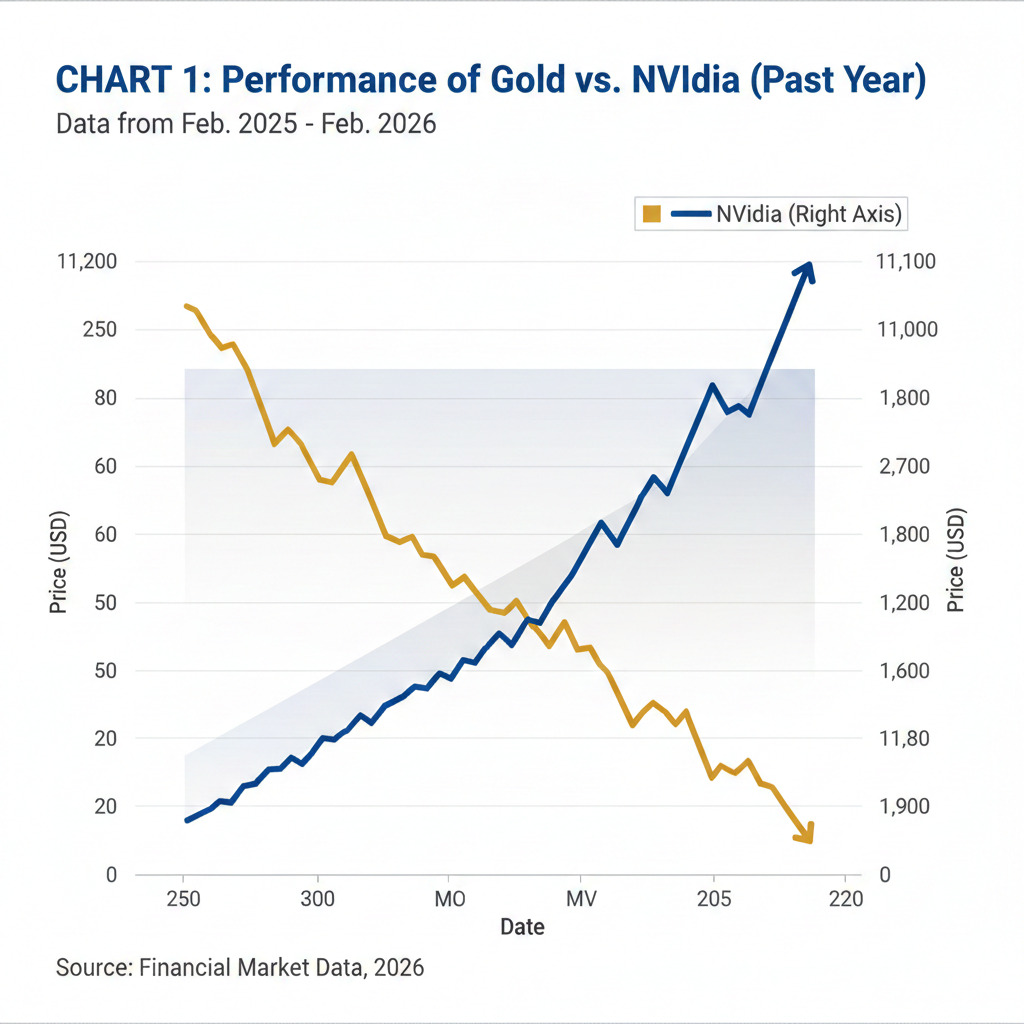
Visualizing the Divergence (Feb 2025 – Feb 2026)
Chart 1: The Descent of Gold vs. NVIDIA’s AI Surge
Disclaimer
Artificial Intelligence Disclosure & Legal Disclaimer
AI Content Policy.
To provide our readers with timely and comprehensive coverage, South Florida Reporter uses artificial intelligence (AI) to assist in producing certain articles and visual content.
Articles: AI may be used to assist in research, structural drafting, or data analysis. All AI-assisted text is reviewed and edited by our team to ensure accuracy and adherence to our editorial standards.
Images: Any imagery generated or significantly altered by AI is clearly marked with a disclaimer or watermark to distinguish it from traditional photography or editorial illustrations.
General Disclaimer
The information contained in South Florida Reporter is for general information purposes only.
South Florida Reporter assumes no responsibility for errors or omissions in the contents of the Service. In no event shall South Florida Reporter be liable for any special, direct, indirect, consequential, or incidental damages or any damages whatsoever, whether in an action of contract, negligence or other tort, arising out of or in connection with the use of the Service or the contents of the Service.
The Company reserves the right to make additions, deletions, or modifications to the contents of the Service at any time without prior notice. The Company does not warrant that the Service is free of viruses or other harmful components.