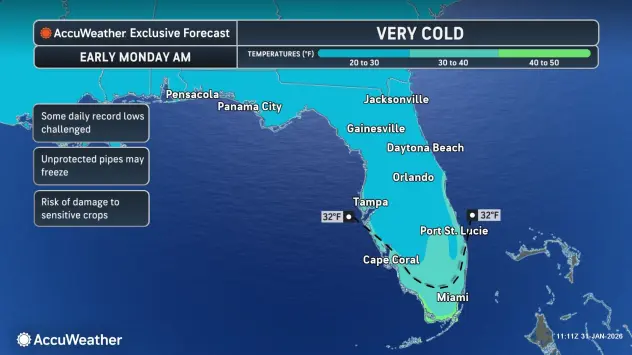
The Sunshine State is currently facing a meteorological event of historic proportions. Residents from the Panhandle down to the Florida Keys are bracing for an Arctic onslaught that many have not experienced in over a decade. This weekend, a massive cold front fueled by a displaced polar vortex has swept southward, transforming the tropical paradise into a frigid landscape and prompting emergency declarations across several counties.
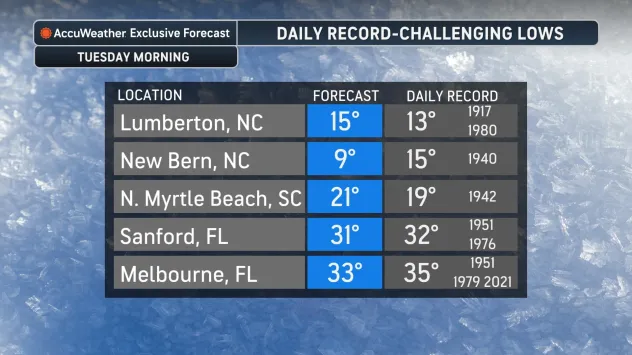 According to a recent report from AccuWeather, “The magnitude of this cold air mass is something we haven’t seen in Florida for quite some time, with some locations potentially facing their lowest temperatures since the historic freezes of 2010 or even earlier.” This assessment underscores the severity of the current weather pattern, which is breaking daily records and challenging the infrastructure of a state designed for heat, not ice.
A Rare and Dangerous Freeze
The cold began its descent on Saturday night, but the full weight of the Arctic air settled in early Sunday morning. In Central Florida, cities like Orlando saw the mercury drop into the mid-20s, while coastal areas like Tampa were stunned by reports of rare snow flurries and sleet. Even South Florida, typically a refuge for those fleeing winter weather, has not been spared. Miami and Fort Lauderdale are experiencing temperatures in the 30s, with wind chills making it feel like the 20s.
The National Weather Service has issued Freeze Warnings and Hard Freeze Warnings for nearly the entire peninsula. For many Floridians, the primary concern is the longevity of the sub-freezing temperatures. A “hard freeze”—defined as temperatures below 28 degrees for several hours—can be devastating to plumbing, tropical vegetation, and local wildlife.

Impact on Agriculture and Wildlife
Florida’s billion-dollar citrus industry is on high alert. Orange and grapefruit groves in the central and southern belts are particularly vulnerable. Farmers have been working around the clock, using irrigation systems to coat trees in a protective layer of ice. While it seems counterintuitive, this ice shield insulates the fruit, keeping it at a steady 32 degrees even as the surrounding air temperature drops significantly.
However, the threat extends beyond the groves. One of the more unique phenomena associated with Florida’s extreme cold is the “falling iguana.” As cold-blooded reptiles, iguanas become immobile when temperatures drop below 40 degrees. They lose their grip on tree branches and fall to the ground in a state of suspended animation. While they usually recover once the sun warms them up, officials have warned residents not to handle the “frozen” lizards, as they can become defensive upon waking.
Power Grids and Public Safety
The sudden spike in heating demand has put an immense strain on Florida’s electrical grid. Utility companies have urged residents to conserve energy where possible, suggesting that thermostats be set to 68 degrees and that large appliances be avoided during peak morning hours.
Public safety officials are also focused on the “Four Ps” of winter weather preparation: People, Pets, Plants, and Pipes. Shelters have been opened across the state for those without adequate heating. In a state where many homes lack central heating or rely on older heat pumps that struggle in sub-freezing air, the risk of fire from space heaters is a major concern. Fire departments have issued stern reminders to keep space heaters at least three feet away from curtains, bedding, and furniture.
Historical Context
This cold snap is being compared to the infamous freeze of January 2010, which caused widespread agricultural damage and killed thousands of acres of mangroves. In some inland areas, meteorologists are looking even further back—to the 1989 or 1977 events—to find comparable temperature readings.
The current setup is the result of a “perfect storm” of meteorological factors: a strong ridge of high pressure over the Western United States has allowed a deep trough to dig into the East, pulling Siberian-origin air directly from the Arctic Circle down to the Gulf of Mexico. Because Florida’s ground is usually moist and warm, the arrival of such dry, cold air causes a rapid, dramatic temperature drop that the local ecosystem is poorly equipped to handle.
Looking Ahead
While the peak of the cold is expected to pass by Monday afternoon, the recovery will be slow. Forecasters suggest that another, albeit weaker, front could reinforce the cold air later in the week. Travelers are advised to check for flight delays, as de-icing operations—a rarity at Florida airports—may slow down departures at major hubs like Orlando International and Miami International.
For now, the Sunshine State remains a “shiver state.” As residents wrap pipes and huddle under blankets, the historic nature of this weekend’s weather serves as a stark reminder of the volatility of modern weather patterns. Whether it is the threat to the breakfast staple of orange juice or the sight of frost on a palm tree, the great Florida freeze of 2026 will likely be talked about for years to come.
Source: AccuWeather
Disclaimer
Artificial Intelligence Disclosure & Legal Disclaimer
AI Content Policy.
To provide our readers with timely and comprehensive coverage, South Florida Reporter uses artificial intelligence (AI) to assist in producing certain articles and visual content.
Articles: AI may be used to assist in research, structural drafting, or data analysis. All AI-assisted text is reviewed and edited by our team to ensure accuracy and adherence to our editorial standards.
Images: Any imagery generated or significantly altered by AI is clearly marked with a disclaimer or watermark to distinguish it from traditional photography or editorial illustrations.
General Disclaimer
The information contained in South Florida Reporter is for general information purposes only.
South Florida Reporter assumes no responsibility for errors or omissions in the contents of the Service. In no event shall South Florida Reporter be liable for any special, direct, indirect, consequential, or incidental damages or any damages whatsoever, whether in an action of contract, negligence or other tort, arising out of or in connection with the use of the Service or the contents of the Service.
The Company reserves the right to make additions, deletions, or modifications to the contents of the Service at any time without prior notice. The Company does not warrant that the Service is free of viruses or other harmful components.