WASHINGTON — In a dramatic reversal of the gridlock that has gripped the nation’s capital for weeks, President Donald Trump and Senate Democratic leaders announced a late-hour agreement on Thursday to avert a partial government shutdown. The deal, struck just one day before a Friday midnight deadline, ensures that the vast majority of federal agencies will remain operational while providing a temporary cooling-off period for the heated debate over immigration enforcement.
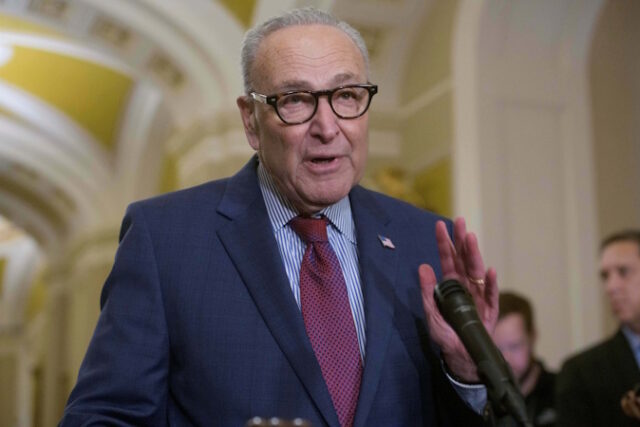
The breakthrough came after a day of high-stakes maneuvering in the Senate, where a procedural vote to advance a six-bill funding package initially failed. Senate Democrats, led by Minority Leader Chuck Schumer (D-NY), had maintained a unified front, refusing to provide the 60 votes needed to advance the legislation unless it included significant reforms to the Department of Homeland Security (DHS) and Immigration and Customs Enforcement (ICE).
The Terms of the Compromise
Under the new bipartisan agreement, the funding package has been effectively split. Five of the six major appropriations bills—covering the Departments of Defense, Labor, Health and Human Services, and Education—will proceed toward immediate passage. These bills will fund approximately 96% of the remaining discretionary federal budget through the end of the fiscal year in September.
To resolve the impasse over the sixth bill, the Department of Homeland Security, both parties agreed to a short-term Continuing Resolution (CR). This measure will keep DHS funded at current levels for several weeks, buying time for negotiators to hammer out specific legislative language regarding the conduct of federal agents.

“I think we’re getting close,” President Trump said during a Cabinet meeting earlier Thursday, signaling a shift toward a more conciliatory tone. “The Democrats, I don’t believe, want to see a shutdown either. So we’ll work in a very bipartisan way… We don’t want a shutdown.”
A Flashpoint in Minneapolis
The negotiations were complicated by a surge of public outcry over recent incidents involving federal agents in Minneapolis. Democrats had made their support for the budget conditional on “common-sense reforms,” which Senator Schumer described as a “masks off, body cameras on” policy.
The demands include:
- A ban on federal agents wearing masks during domestic operations.
- Mandatory use of body cameras for all ICE and Border Patrol agents.
- A uniform federal code of conduct and independent oversight for use-of-force incidents.
- Stricter requirements for coordination with local law enforcement and the use of judicial warrants.
“Until ICE is properly reined in and overhauled legislatively, the DHS funding bill doesn’t have the votes to pass,” Schumer had warned on Wednesday. The compromise reached today allows Democrats to claim a tactical victory by separating the DHS budget, while allowing the Trump administration to avoid the political and economic fallout of a shuttered government.
Economic and Political Stakes
The threat of a shutdown carried significant weight following the historic 43-day closure that ended in late 2025. That previous standoff cost the U.S. economy billions and left federal workers without pay for over a month. Lawmakers on both sides were reportedly eager to avoid a repeat of that chaos, especially with several key agencies already operating under full-year funding passed earlier this month.
Republicans, led by Senate Majority Leader John Thune (R-SD), initially pushed for the full six-bill package to pass as a single unit. However, as the deadline neared and seven Republican senators broke ranks to vote against the procedural motion, the GOP leadership pivoted toward the split-bill strategy.
“We hoped to process all of the six bills, but we are where we are,” Thune remarked following the agreement. “The goal is the best possible outcome for the American people, and that means keeping the lights on.”
What Stays Open
By passing the five bipartisan bills, Congress ensures that critical services remain uninterrupted. This includes:
- National Institutes of Health (NIH): Rebuffing the administration’s proposed 40% cut, the deal maintains $48.7 billion in funding for biomedical research.
- Education: Funding for Pell Grants and programs for low-income students will remain stable at roughly $79 billion.
- National Security: The Pentagon and State Department will receive their full-year allocations, ensuring continuity in defense operations and foreign policy.
The Road Ahead
While the agreement stops a shutdown for now, it merely delays the final confrontation over immigration policy. The short-term CR for the Department of Homeland Security sets up a new deadline in the coming weeks. If negotiators cannot agree on the “code of conduct” for ICE agents by then, the threat of a partial shutdown will return.
Furthermore, because the House of Representatives is currently out of session, a brief “technical” shutdown may still occur over the weekend. However, White House officials noted that since most government offices are closed on Saturday and Sunday, the impact will be negligible if the House moves quickly to ratify the Senate’s deal on Monday.
For a nation weary of “brinkmanship” politics, the deal represents a rare moment of functional compromise in a deeply divided Washington. Whether this bipartisan spirit lasts long enough to resolve the underlying disputes over border security and civil liberties remains the major question for 2026.
Sources & Links
- The Guardian: Senate fails to advance spending package after Democrats refuse to back DHS funding
- Associated Press: Democrats and White House reach deal to avert shutdown
- CBS News: Senate fails to advance funding package ahead of shutdown deadline as ICE talks continue
- TIME Magazine: Democrats Reveal Their 3 Demands to Avoid a Shutdown
- MPR News: Democrats block government funding package in Senate as negotiations continue
Disclaimer
Artificial Intelligence Disclosure & Legal Disclaimer
AI Content Policy.
To provide our readers with timely and comprehensive coverage, South Florida Reporter uses artificial intelligence (AI) to assist in producing certain articles and visual content.
Articles: AI may be used to assist in research, structural drafting, or data analysis. All AI-assisted text is reviewed and edited by our team to ensure accuracy and adherence to our editorial standards.
Images: Any imagery generated or significantly altered by AI is clearly marked with a disclaimer or watermark to distinguish it from traditional photography or editorial illustrations.
General Disclaimer
The information contained in South Florida Reporter is for general information purposes only.
South Florida Reporter assumes no responsibility for errors or omissions in the contents of the Service. In no event shall South Florida Reporter be liable for any special, direct, indirect, consequential, or incidental damages or any damages whatsoever, whether in an action of contract, negligence or other tort, arising out of or in connection with the use of the Service or the contents of the Service.
The Company reserves the right to make additions, deletions, or modifications to the contents of the Service at any time without prior notice. The Company does not warrant that the Service is free of viruses or other harmful components.