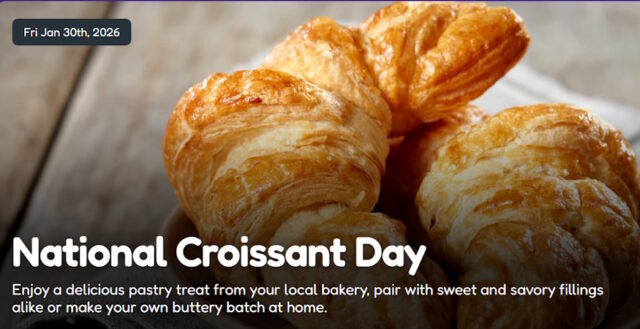
While most of us know it as a french speciality, the croissant actually originated in Austria under the name “kipferls”. Marie Antoinette first introduced the Austrian pastry to France when she married into the royal family and requested the simple crescent-shaped cake of her homeland. The French bakers created fancier versions of “kipferls” and thus, the croissant was born. In France, the croissant has become more sophisticated, influenced by the country’s cuisine. At its most basic level, it’s a frugal kind of breakfast pastry, made from pâte feuilletée (soft flour, yeast, butter, milk, and salt). On January 30, we annually recognize National Croissant Day, so channel your inner Parisian baker today and say “oui” to these buttery treats!
- 1683 – The first recorded origin of the croissant dates to the Battle of Vienna, when it was created to celebrate the defeat of the Ottoman attack on the city, with the shape referring to the crescents on the Ottoman flags.
- 17th Century – The first recipe for croissants appeared in “Le Pâtissier françois” by François Pierre de La Varenne, better known as ‘puff pastry.’
- 1770s – Fifteen-year-old Marie leaves Vienna for France to marry, and the (highly debated) story goes that she introduces the croissant to her new homeland.
- 1800s – The first documentation of the croissant in France was in an upscale patisserie named the ‘Boulangerie Viennoise.’
- 1837 – Boulangerie Viennoise (known as “Zang’s”) is a Paris bakery specializing in Austrian-style baked goods. This bakery only operated for two years, but its impact would change the world of French baked goods forever, as it is likely responsible for introducing the “kipferl”, which eventually became the croissant.
- 1869 – The croissant was established enough to be mentioned as a breakfast staple,
- 1872 – Charles Dickens wrote (in his periodical All the Year Round) of “the workman’s pain de ménage and the soldier’s pain de munition, to the dainty croissant on the boudoir table.”
- 1910s – While the idea of Viennese-style pastries was embraced by the French decades earlier, it wasn’t until this time that the treats were made using puff pastry combined with yeast, which changes the texture into something more like the flaky, layered treat of today.
- 1915 – Sylvain Claudius Goy, a French baker, penned the recipe for the croissants we all know and enjoy today.
- 1920 – The Croissant became the French national product.
- 1920s – As the process of making these pastries is somewhat labor-intensive and expensive, they remain a luxury good for some time. Finally, around the time of WWII, the croissant became more available to the masses
- 1939 – Credit for the croissant we know today is given to an Austrian military officer, August Zang. In 1939, he opened a Viennese bakery in Paris, introducing French bakers to Viennese techniques.
- 1981 – Sara Lee introduced a frozen croissant, which soon outpaced its famous pound cakes in sales. Burger King, Arby’s, and other fast-food chains followed with croissant breakfast sandwiches and savory stuffed croissants.
- 1984 – The New York Times article declared, “The Americanization of the croissant” had begun.
- 2006 – National Croissant Day dates back to 2006, but the star of the show has a history that is obviously much older!
- 2013 – The French newspaper Le Figaro named the croissant from the bakery Pierre Hermé the best in Paris. It also won in 2006.
- 2013 – Chef Dominque Ansel came up with the cronut — a deep-fried croissant/doughnut combination that became all the rage at his New York bakery.
- 2016 – In February 2016, Tesco, a UK supermarket, said all its croissants would be curveless. That’s despite the fact that its name literally means ‘crescent’.
- Legend surrounds this pastry, as is often the case with a popular, worldly treat. What is known is that crescent-shaped breads have been found around the world for ages. One of these was the Kipferl, which originated in Austria as far back as the 13th century. This non-laminated bread is more like a roll.
- Each croissant roll is made of 50 or more thin layers of pastry & butter.
- According to legend, it was Marie Antoinette (Austrian Princess who married Louis XVI), who introduced the croissant to France.
- In France, croissants are typically bought fresh daily and served with jams and jellies for breakfast.
- Since Starbucks bought French baker Pascal Rigo’s San Francisco-based La Boulange, the chocolate croissant has become the coffee chain’s bestselling pastry.
- The croissant started as a luxury product, but by the end of the nineteenth century, it had become middle-class (the rich preferred a good brioche).
- Before the modern croissant, puff pastry was used as a garnish or shell, not to eat on its own.
- The chocolate croissant is called a pain au chocolat because it is not shaped like a crescent.
- It’s estimated that around 85 percent of croissants sold in French bakeries are industrially manufactured.
Sources:

Disclaimer
Artificial Intelligence Disclosure & Legal Disclaimer
AI Content Policy.
To provide our readers with timely and comprehensive coverage, South Florida Reporter uses artificial intelligence (AI) to assist in producing certain articles and visual content.
Articles: AI may be used to assist in research, structural drafting, or data analysis. All AI-assisted text is reviewed and edited by our team to ensure accuracy and adherence to our editorial standards.
Images: Any imagery generated or significantly altered by AI is clearly marked with a disclaimer or watermark to distinguish it from traditional photography or editorial illustrations.
General Disclaimer
The information contained in South Florida Reporter is for general information purposes only.
South Florida Reporter assumes no responsibility for errors or omissions in the contents of the Service. In no event shall South Florida Reporter be liable for any special, direct, indirect, consequential, or incidental damages or any damages whatsoever, whether in an action of contract, negligence or other tort, arising out of or in connection with the use of the Service or the contents of the Service.
The Company reserves the right to make additions, deletions, or modifications to the contents of the Service at any time without prior notice. The Company does not warrant that the Service is free of viruses or other harmful components.