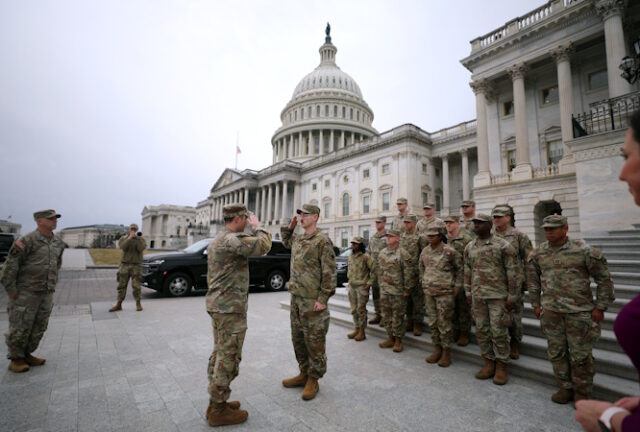
In recent months, the sight of camouflaged uniforms on American city streets has moved from a rare emergency occurrence to a semi-permanent fixture of the domestic landscape. While the political and social implications of using the military for domestic law enforcement-style duties are often the focus of public debate, a quieter but equally significant concern is emerging: the staggering cost to the American taxpayer. New data from the Congressional Budget Office (CBO) and independent budget watchdogs suggest that these deployments are not merely symbolic—they are an expensive logistical undertaking that could cost the public over $1.1 billion this year alone.
The Daily Price of “Boots on the Ground”
The fiscal reality of deploying a single service member is far more complex than a simple paycheck. According to the CBO, the cost to maintain one National Guard member on active federal status for domestic operations ranges from $311 to $607 per day. This figure includes basic pay, health care, housing allowances, and “subsistence”—the military’s term for food.
When these individual costs are aggregated across thousands of troops, the numbers escalate rapidly. In Washington, D.C., where approximately 2,690 Guard members remain stationed, the operation is hemorrhaging roughly $1 million per day. By the end of 2026, the D.C. mission alone is projected to reach a price tag of $660 million.
A Breakdown of Deployment Expenses
To understand where the money goes, one must look at the logistical tail that follows every soldier. The CBO categorizes these expenses into four primary buckets:

- Military Pay and Benefits: When Guard members are federalized, they move from part-time “drill” status to full active-duty pay. This increase in personnel costs is estimated at approximately $95,000 per person per year, or $260 per day, above their standard civilian/reserve costs.
- Lodging and Per Diem: Unlike overseas combat deployments where troops might live in tents or “B-Huts,” domestic urban deployments often require the government to rent out entire blocks of hotel rooms or utilize commercial lodging, significantly driving up costs.
- Logistics and Transportation: Moving thousands of troops, along with their equipment and support staff, via military aircraft or chartered buses involves massive fuel and maintenance outlays.
- Administrative Overhead: The “hidden” costs include medical screenings before and after deployment, administrative out-processing, and the replenishment of gear.
The Geography of Spending
The financial burden is not distributed evenly, as costs vary based on the local cost of living and the specific duration of the mission. Recent estimates for 2025 and 2026 deployments show a significant drain on federal resources across several major hubs:
| City | Estimated Cost (2025-2026) |
| Washington, D.C. | $660 Million (Projected) |
| Los Angeles | $193 Million |
| Memphis | $33 Million |
| Portland | $26 Million |
| Chicago | $21 Million |
The CBO notes that for any new deployment ordered in 2026, taxpayers can expect to pay between $18 million and $21 million per month for every 1,000 soldiers sent into a U.S. city.
Opportunity Costs and “Readiness Atrophy”
Beyond the direct line items in the Pentagon’s budget, experts point to “opportunity costs.” Critics, including policy analysts from Taxpayers for Common Sense, argue that using the military for crime prevention is fiscally inefficient. Federalized Guard members are generally prohibited from performing actual law enforcement duties, such as making arrests or conducting searches.
“It would be far more cost-effective to invest in local law enforcement,” argues Gabe Murphy, a policy analyst. From a purely economic standpoint, the “return on investment” for a soldier acting as a visual deterrent is significantly lower than that of a trained police officer who can process cases and clear investigations.
Furthermore, there is the issue of readiness. The National Guard is the nation’s primary response force for natural disasters like hurricanes and wildfires. When units are tied up in long-term urban patrols, they are not training for their core missions, and the frequent mobilizations place a strain on their civilian employers and families.
Conclusion
As the federal defense budget surpasses the $1 trillion mark for the first time in history, the scrutiny over domestic troop spending is intensified. While proponents argue that the presence of troops provides a necessary “sense of security,” the data suggests that this security comes with a premium price tag. With the CBO projecting that continued deployments will require an additional $93 million per month, the debate is no longer just about policy—it is about the sustainable use of the American treasury.
Sources & Links
- CBO: Estimating the Costs of Troop Deployments to U.S. Cities
- Maine Public: Trump’s National Guard deployments could cost over $1 billion this year
- Taxpayers for Common Sense: How Much Are National Guard Deployments Costing Taxpayers?
- Institute for Policy Studies: FACT SHEET: What Do Trump’s National Guard Deployments Cost?
- News4JAX: Federal troop deployments to US cities cost taxpayers $496M and counting
Disclaimer
Artificial Intelligence Disclosure & Legal Disclaimer
AI Content Policy.
To provide our readers with timely and comprehensive coverage, South Florida Reporter uses artificial intelligence (AI) to assist in producing certain articles and visual content.
Articles: AI may be used to assist in research, structural drafting, or data analysis. All AI-assisted text is reviewed and edited by our team to ensure accuracy and adherence to our editorial standards.
Images: Any imagery generated or significantly altered by AI is clearly marked with a disclaimer or watermark to distinguish it from traditional photography or editorial illustrations.
General Disclaimer
The information contained in South Florida Reporter is for general information purposes only.
South Florida Reporter assumes no responsibility for errors or omissions in the contents of the Service. In no event shall South Florida Reporter be liable for any special, direct, indirect, consequential, or incidental damages or any damages whatsoever, whether in an action of contract, negligence or other tort, arising out of or in connection with the use of the Service or the contents of the Service.
The Company reserves the right to make additions, deletions, or modifications to the contents of the Service at any time without prior notice. The Company does not warrant that the Service is free of viruses or other harmful components.