A “potentially historic” winter storm, unofficially named Winter Storm Fern, has effectively split the United States in two, blanketing more than 50% of the nation in a dangerous mix of heavy snow and “catastrophic” ice. From the Mexico border to the Canadian line, the 2,000-mile-long system has triggered emergency declarations in 24 states and left approximately 230 million people under winter weather alerts. As of Monday evening, the death toll has tragically risen to at least 49 people, according to confirmed reports, as the system begins to transition into a powerful nor’easter in the Atlantic.
The sheer scale of the storm is unprecedented in recent years. Fueled by an elongated polar vortex clashing with moisture from the Gulf and Pacific, the system has dropped a swath of snow ranging from 12 to 24 inches from Texas to Maine. In the South and Mid-Atlantic, the weather has proven particularly lethal, with heavy ice accumulation snapping power lines and trapping millions in freezing conditions.

Top 10 Snowfall Totals by City
While the storm impacted dozens of major metropolitan areas, the Sierra Blanca mountains of New Mexico and the coastal regions of New England saw the highest overall accumulations. The following cities recorded the most significant snowfall as of January 26, 2026:
| Rank | City/Location | Snowfall Amount |
| 1 | Bonito Lake, NM | 31.0 inches |
| 2 | Stratham, NH | 21.0 inches |
| 3 | West Mayfield, PA | 20.0 inches |
| 4 | Holden, MA | 20.0 inches |
| 5 | Exeter, NH | 19.0 inches |
| 6 | Winsted, CT | 18.2 inches |
| 7 | Derry, NH | 18.0 inches |
| 8 | New City, NY | 17.6 inches |
| 9 | Boston, MA | 15.0 inches |
| 10 | Pittsburgh, PA | 13.8 inches |
Aviation and Infrastructure: A Nation at a Standstill
The aviation industry is reeling from what analysts call the most significant weather-related disruption since the pandemic. Sunday, January 26, set a grim record with over 12,500 flight cancellations nationwide. Major hubs like Dallas-Fort Worth and Nashville saw near-complete closures, with Southwest Airlines reportedly canceling 100% of its Nashville operations during the peak of the storm.
On Monday, the “cascading effect” of grounded crews and displaced aircraft led to an additional 3,900 cancellations by mid-afternoon. Carriers including American, United, and JetBlue have issued widespread travel waivers, warning that a return to normal operations may not occur until Thursday.
The power grid has fared little better. At the storm’s peak, over 1 million customers were without electricity. Hardest hit were Tennessee, Mississippi, and Louisiana, where a “once-in-a-generation” ice storm coated trees and lines in up to an inch of ice. In Texas, the Department of Energy issued emergency orders to deploy backup generators at data centers to stabilize the ERCOT grid.
Forecast: Bitter Cold and Lingering Dangers
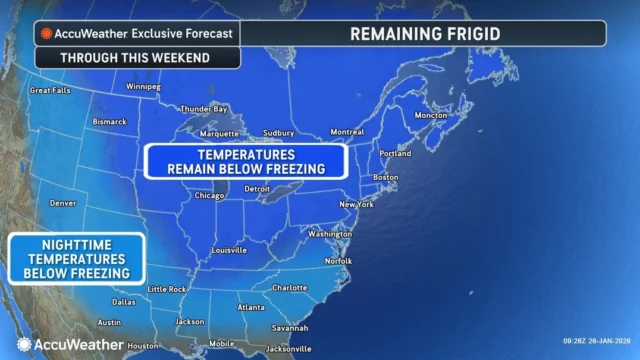
As the storm pulls away from the Northeastern coastline, the immediate threat of falling snow is being replaced by a surge of Arctic air. Meteorologists warn of “dangerously cold” wind chills reaching as low as $-31°C$ ($-25°F$) across the Great Lakes and Northeast.
While the heavy precipitation has ended for most of the Central U.S., the National Weather Service (NWS) cautions that the “deep freeze” will prevent significant melting, keeping roads impassable. In the South, where ice remains the primary concern, the NWS predicts that below-freezing temperatures will persist for several days, complicating power restoration efforts for the hundreds of thousands still in the dark.
Sources & Links:
- National Weather Service: Winter Storm Summary January 24-26, 2026
- FEMA: President Trump Approves Historic Emergency Declarations
- Wikipedia: January 2026 North American Winter Storm
- CBS News: Snow Storm Forecast Maps and Totals
- Travel Market Report: Record 12,500 Flight Cancellations
- ABC10: National Snow Totals and Top 10 Lists
Disclaimer
Artificial Intelligence Disclosure & Legal Disclaimer
AI Content Policy.
To provide our readers with timely and comprehensive coverage, South Florida Reporter uses artificial intelligence (AI) to assist in producing certain articles and visual content.
Articles: AI may be used to assist in research, structural drafting, or data analysis. All AI-assisted text is reviewed and edited by our team to ensure accuracy and adherence to our editorial standards.
Images: Any imagery generated or significantly altered by AI is clearly marked with a disclaimer or watermark to distinguish it from traditional photography or editorial illustrations.
General Disclaimer
The information contained in South Florida Reporter is for general information purposes only.
South Florida Reporter assumes no responsibility for errors or omissions in the contents of the Service. In no event shall South Florida Reporter be liable for any special, direct, indirect, consequential, or incidental damages or any damages whatsoever, whether in an action of contract, negligence or other tort, arising out of or in connection with the use of the Service or the contents of the Service.
The Company reserves the right to make additions, deletions, or modifications to the contents of the Service at any time without prior notice. The Company does not warrant that the Service is free of viruses or other harmful components.