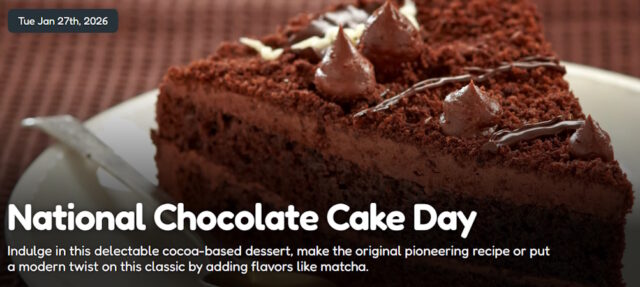
National Chocolate Cake Day celebrates the cake more people favor. And more often than not, we celebrate our special occasions like anniversaries, birthdays and weddings with cake. Why not enjoy chocolate cake on January 27th every year?
- 1562 – The saying “You can’t have your cake and eat it”(originally “eat your cake and have it”) is first seen in print in 1562 in John Heywood’s ‘Proverbs and Epigrams.’
- 1764 – The history of chocolate cake goes back to 1764 when Dr. James Baker discovered how to make chocolate
- 1785 – The first reference to ‘birthday cake’ came in 1785.
- 1832 – Sachertorte is a famous Viennese cake. It is the most famous chocolate cake in the world.
- Sachertorte was invented by Austrian Franz Sacher in 1832 for Prince Wenzel von Metternich in Vienna, Austria.
- 1847 – A popular Philadelphia cookbook author, Eliza Leslie, published the earliest chocolate cake recipe in 1847 in The Lady’s Receipt Book.
- 1879 – The conching process was developed by Rodolphe Lindt to make chocolate smoother and silkier.
- 1920s – The first boxed cake mix was created by O. Duff and Sons in the late 1920s.
- 1947 – Betty Crocker released its first dry cake mixes.
- 1948 – Pillsbury introduced chocolate flavor. Before then, there were only a few flavors of cake mixes, such as yellow, white, spice, and ginger, made by General Mills.
- 1957 – Created in the United States using the “German’s” brand of chocolate, this cake, covered in coconut-caramel frosting, is featured in the Dallas Morning Star newspaper.
- 1967 – Making little chocolate cakes accessible to just about anyone, even on the go, Hostess Brands supplies North America with these little cream-filled, chocolate-covered cakes. About the size of hockey pucks (but a bit taller), in Canada, they are known as King Dons.
- 1990 – Molten Lava cakes with liquid chocolate centers became popular.
- German chocolate cake has nothing to do with Germany. The cake itself is from the United States and bears the name of Samuel German. German developed a formulation for the dark baking chocolate used in his cake.
- A chocolate cake is also known as a Mahogany Cake.
- The word ‘cake’ comes from Middle English kake, and is probably a borrowing from Old Norse.
- The meaning of ‘cake’ has changed over time, and the first cake was: A comparatively small flattened sort of bread, round, oval, or otherwise regularly shaped, and usually baked hard on both sides by being turned during the process.
- In Scotland, and parts of Wales and northern England, cake took on the specific meaning of ‘a thick, hard biscuit made from oatmeal’.
- More than 29% of U.S. school districts have banned bake sales due to anti-obesity regulations.
- The French word for chocolate mousse translates in English as “chocolate mayonnaise.”
- The “blood” that you see in the infamous “shower scene” in Psycho is actually chocolate syrup.
- The term “chocolate cake” means a white or yellow cake with a side order of a chocolate beverage.
- The darker the chocolate, the more caffeine it will have. Add chocolate frosting and the caffeine content increases, too.
Sources:

Just Fun Facts
Disclaimer
Artificial Intelligence Disclosure & Legal Disclaimer
AI Content Policy.
To provide our readers with timely and comprehensive coverage, South Florida Reporter uses artificial intelligence (AI) to assist in producing certain articles and visual content.
Articles: AI may be used to assist in research, structural drafting, or data analysis. All AI-assisted text is reviewed and edited by our team to ensure accuracy and adherence to our editorial standards.
Images: Any imagery generated or significantly altered by AI is clearly marked with a disclaimer or watermark to distinguish it from traditional photography or editorial illustrations.
General Disclaimer
The information contained in South Florida Reporter is for general information purposes only.
South Florida Reporter assumes no responsibility for errors or omissions in the contents of the Service. In no event shall South Florida Reporter be liable for any special, direct, indirect, consequential, or incidental damages or any damages whatsoever, whether in an action of contract, negligence or other tort, arising out of or in connection with the use of the Service or the contents of the Service.
The Company reserves the right to make additions, deletions, or modifications to the contents of the Service at any time without prior notice. The Company does not warrant that the Service is free of viruses or other harmful components.