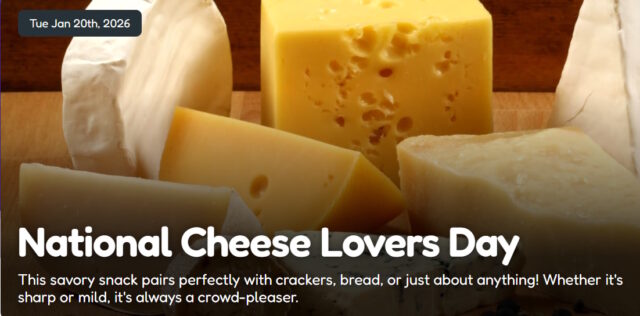
On National Cheese Lover’s Day, don’t feel bleu, throw a feta or act capricious. January 20th is a gouda day to kummin over and have some cheddar or asiago or fontina!
- 5500 BC – The earliest record of cheese-making dates back to 5,500 BCE in what is now Poland.
- 100 BC – During the Roman Empire, cheesemaking had widely become a valued practice in the Middle East and Europe.
- 17th Century – Cheese production started in America after English dairy farmers brought their farming and cheesemaking knowledge with them to New English colonies.
- 1831 – The first farmstead cheese factory was opened in Koshkonong, Wisconsin.
- 1902 – A recipe for a “Melted Cheese,” designed to be cooked in a hot oven, appeared in Sarah Tyson Rorer’s “Mrs. Rorer’s New Cook Book;”
- 1913 – With the invention of the refrigerator, cheese preservation became better and more utilized for homes.
- 1915 – Processed American cheese was developed by J. L. Kraft (founder of Kraft Foods) as an alternative to traditional cheeses with short shelf lives.
- 1920s – Grilled cheese sandwiches originally showed up in America during the 1920s
- 1929 – A recipe published in 1929 in Florence A. Cowles’ “Seven Hundred Sandwiches” called to broil the ingredients to make “Toasted Cheese;”
- 1939 – “Toasted Sandwich,” published in “The Boston Cooking School Cook Book,” encouraged preparers to broil the ingredients or even — gasp! — sautee them in a frying pan coated with butter
- 1953 – “The Joy of Cooking” (1953), by Irma S. Rombauer, wrote that bread and cheese should be heated in a commercial waffle iron — an easy meal for even “the maidless host” to prepare.
- 2005 – A study by the British Cheese Board in 2005 showed that cheese has positive effects on sleep
- 2016 – scientists and experts named Vieux Boulogne as the smelliest cheese. The cheese which comes from Boulogne Sur Mer in Northern France is soft and beats 14 other kinds of cheese.
- There is no firm evidence of how cheese-making was discovered. But thousands of years ago, people transported milk stored in sheep’s stomachs. Left to sit a few days, the proteins would separate into curds and whey.
- The oldest known cheese was found in a 3,200-year-old Egyptian tomb. Scientists believe it likely had a sour, crumbly texture, similar to goat cheese. This ancient cheese carried traces of bacteria, making it possibly hazardous if tasted today.
- From there, preserving the solids with salt may have seemed a logical next step. Salt was a highly valued preservative in ancient times.
- There are over 2,000 varieties of cheese.
- 5 — the number of years it would take to try one cheese per day.
- Cheeses are more flavorful at room temperature. Let them stand for a half-hour before serving.
- Cheese is an ancient food whose origins predate recorded history.
- Cheese is derived from the Latin word ‘caseus.’
- Some studies claim that cheddar, mozzarella, Swiss, and American cheeses can help to prevent tooth decay.
- The most recognizable characteristic of Swiss cheese is its holes, which punctuate the pale yellow exterior. These holes, also called “eyes,” are caused by the expansion of gas within the cheese curd during the ripening period.
- Contrary to popular belief, not all Swiss cheese has holes. Varieties like Emmental do, but others, including Gruyère, are solid. The holes result from bacterial activity during aging.
- A 1935 Wisconsin law required restaurants to serve cheese with every meal. It was repealed in 1937.
- The terms “Big Wheel” and “Big Cheese” originally referred to those who were wealthy enough to purchase a whole wheel of cheese.
- Almost 90% of all cheese sold in the United States is classified as a Cheddar-type cheese.
- More cheese is produced than the combined worldwide production of coffee, chocolate, and tea put together. A mighty 20 million metric tons of cheese are produced worldwide each year.
- The people of Greece are the world’s largest consumers of cheese, eating around 27.3kg (60.1 pounds) of it every year. Their favorite is feta.
- 57,518 pounds — the weight of the heaviest cheese prepared in the world by a Canadian cheesemaker.
- 300 million pounds — the amount of cheese used annually by Pizza Hut.
- 70% — the percentage of Americans who prefer American cheese on their burgers.
- 1/10 — the volume of milk that evaporates when the cheese is made.
- 33 pounds — the amount of cheese eaten by an American adult every year.
- A cheese expert is called a cheesemonger.
- Pule cheese, made from Serbian donkey milk, is one of the rarest and most expensive cheeses globally. Due to its labor-intensive production, it costs over $1200 per kilogram (2.2 pounds).
- Blue cheeses are usually aged in a temperature-controlled environment such as a cave or a cellar.
- The most popular cheese recipe in the United States is macaroni and cheese.
- Sardinia, one of the Blue Zones known for long life spans, is home to a unique sheep’s-milk cheese called Pecorino. This cheese has high levels of omega-3 fatty acids, which locals believe support heart health.
Sources:

Disclaimer
Artificial Intelligence Disclosure & Legal Disclaimer
AI Content Policy.
To provide our readers with timely and comprehensive coverage, South Florida Reporter uses artificial intelligence (AI) to assist in producing certain articles and visual content.
Articles: AI may be used to assist in research, structural drafting, or data analysis. All AI-assisted text is reviewed and edited by our team to ensure accuracy and adherence to our editorial standards.
Images: Any imagery generated or significantly altered by AI is clearly marked with a disclaimer or watermark to distinguish it from traditional photography or editorial illustrations.
General Disclaimer
The information contained in South Florida Reporter is for general information purposes only.
South Florida Reporter assumes no responsibility for errors or omissions in the contents of the Service. In no event shall South Florida Reporter be liable for any special, direct, indirect, consequential, or incidental damages or any damages whatsoever, whether in an action of contract, negligence or other tort, arising out of or in connection with the use of the Service or the contents of the Service.
The Company reserves the right to make additions, deletions, or modifications to the contents of the Service at any time without prior notice. The Company does not warrant that the Service is free of viruses or other harmful components.