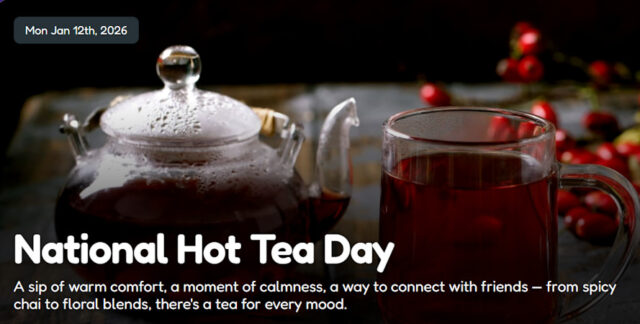
The perfect time for a cup of tea is National Hot Tea Day, on January 12 every year. Tea has been in our cups since the 2nd century B.C. Originating in China, tea has become the second most consumed beverage in the world, after water. This delicious blend of spices energizes, detoxifies, relaxes, and does so much more.
- 2732 BC – According to legend, Emperor Shen Nung discovered tea when leaves from a wild tree blew into his pot of boiling water.
- 59 BC – The Han dynasty work, “The Contract for a Youth,” contains the first known reference to boiling tea.
- 1607 – The first shipment of tea to Europe is recorded by the Dutch East India Company.
- 1657 – Tea was first sold in a coffee house in London.
- 1662 – Catherine of Braganza took the tea-drinking habit to the English court when she married Charles II.
- 1773 – The Sons of Liberty destroy an entire shipment of tea sent by the East India Company, in opposition to the violation of rights in the Townshend Act.
- 1785 – Tea smuggling during the 18th century made tea accessible to the public. The British government removed the tax on tea, thereby eliminating the smuggling trade
- 1830s – Earl Grey tea was named after an actual man – Lord Charles Grey, 2nd Earl Grey
- 1840 – British Tea Time began because of a hungry lady. Anna Russel, the Duchess of Bedford, found herself languishing every afternoon between lunch and dinner. So she dreamed up a light meal with tea that could double as a social affair.
- 1901 – Two women filed a patent for a tea-leaf holder. Seven years later, an American importer reportedly began selling silk pouches containing samples of his latest teas. While he didn’t intend for it to happen, customers started dunking them straight into the water.
- 1920s – Commercial production begins, replacing silk with cheaper gauze and eventually paper.
- 2020 – global tea consumption topped 6.3 billion kilograms (nearly 14 million pounds).
- The global tea industry was estimated to be worth $207.1 billion in 2020; it is forecast to be worth $266.7 billion by 2025.
- Tea offers multiple health benefits, including improved digestion, antioxidants, reduced stress, and pain relief.
- The ideal temperature for your tea is below 150° F (65° C).
- The ideal brewing temperature for Green and white teas is 175-180 degrees Fahrenheit, while the strongest variety, black tea, requires boiling water at 212 degrees Fahrenheit.
- The colder something is, the harder it is for taste buds to detect its subtleties. Science agrees that hot tea is better.
- All tea — be it black, green, oolong, white, or yellow — comes from the same plant, the Camellia sinensis. Of course, this excludes herbal teas and tisanes, which are technically not “true” teas but are permitted to live in the tea universe
- It’s estimated that three billion cups of tea are consumed globally per day. Considering there are just shy of eight billion people in the world, that’s a pretty high ratio.
- There are over 3000 varieties of tea.
- Panda dung tea is made using panda poo as an eco-friendly fertilizer. This method is said to retain more nutrients than non-panda-poo-fertilized tea and to yield a tea that’s fragrant and smooth. However, consuming panda poo comes at a cost. It is among the world’s most expensive teas, with about 16 cups worth fetching roughly $3500.
- Some herbal teas contain caffeine.
- Yerba mate, a South American tea that’s made from a member of the holly family.
- Yaupon tea, also called cassina, is from the same family of holly.
- Coffee berry tea. This tea is made from the dried skins of coffee berries
- 84% of the tea consumed in America is black tea — of that, 75-85% is served as iced tea.
- Most Americans refer to fancy tea as “high tea.” But they’re wrong. The term “high tea” originated as a reference to the height of the tables served — bar tables.
- Aside from water, tea is the most popular drink in the world.
- The art of reading tea leaves is called tasseography.
- Queen Anne drank tea so regularly that she substituted a large bell-shaped silver teapot for the tiny Chinese teapots. The earliest tea service dates from her reign.
- Tea cups didn’t always have handles. At first, the English made cups without handles, influenced by the traditional Chinese tea bowls.
- There may be an easy way to save your pearly whites from tea stains. In a study published in the International Journal of Dental Hygiene, adding a splash of milk was found to be surprisingly effective in preventing them.
- Technically, you should pour the milk in first. While this is a hotly debated topic, it turns out that pouring the milk into the mug first may have scientific benefits. According to a study by Dr. Stapley of Loughborough University, adding milk after the tea has heated unevenly dilutes the flavor.
- Don’t toss those old bags! Some gardening experts believe that watering plants with weak tea fertilizes the soil. Or. Use them to degrease dirty pots and pans: Soak dishes in warm water with a couple of tea bags and watch stuck-on food previously slide off with the swipe of a sponge.
- Medical studies show that green tea may help kill oral cancer cells, improve brain scans in cancer patients, and ward off prostate cancer.
- Tea contains a special amino acid called L-theanine, which, research suggests, may help you focus and relax your mind without making you feel drowsy.
- It takes about 2,000 small leaves to make one pound of tea.
- Tea contains only a few calories per cup. It’s everything that’s added afterward, such as sugar, that’s less healthy.
- Don’t let extra tea bags go to waste. Steep them as you normally would, allow them to cool, and place them on your eyelids. The antioxidants help lessen inflammation, reduce puffiness, and tighten skin. It’s why you’ll often find tea in skincare products like lotions and face masks.
- Ancient Chinese and Japanese cultures revered tea for its calming properties, often linking it to meditation.
- In China, monks used tea to maintain alertness during long meditation sessions, while Japanese tea ceremonies grew from Zen Buddhist practices for achieving harmony and mindfulness.
Sources:

Disclaimer
Artificial Intelligence Disclosure & Legal Disclaimer
AI Content Policy.
To provide our readers with timely and comprehensive coverage, South Florida Reporter uses artificial intelligence (AI) to assist in producing certain articles and visual content.
Articles: AI may be used to assist in research, structural drafting, or data analysis. All AI-assisted text is reviewed and edited by our team to ensure accuracy and adherence to our editorial standards.
Images: Any imagery generated or significantly altered by AI is clearly marked with a disclaimer or watermark to distinguish it from traditional photography or editorial illustrations.
General Disclaimer
The information contained in South Florida Reporter is for general information purposes only.
South Florida Reporter assumes no responsibility for errors or omissions in the contents of the Service. In no event shall South Florida Reporter be liable for any special, direct, indirect, consequential, or incidental damages or any damages whatsoever, whether in an action of contract, negligence or other tort, arising out of or in connection with the use of the Service or the contents of the Service.
The Company reserves the right to make additions, deletions, or modifications to the contents of the Service at any time without prior notice. The Company does not warrant that the Service is free of viruses or other harmful components.