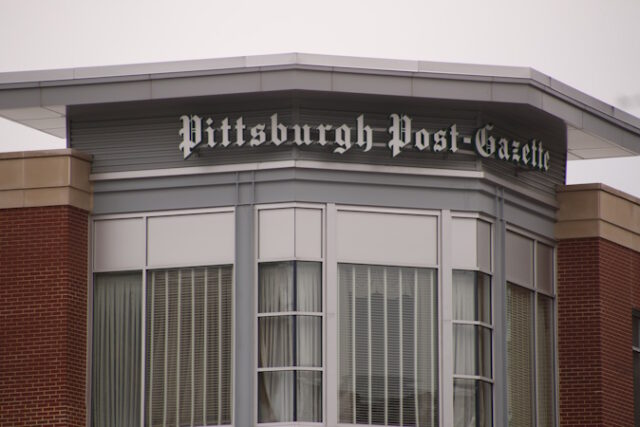
PITTSBURGH — In a move that marks the end of an era for American journalism west of the Alleghenies, the Pittsburgh Post-Gazette announced Wednesday that it will cease all operations on May 3, 2026. The decision shutters a 240-year-old institution that has chronicled the city’s history from the Whiskey Rebellion to the collapse of the steel industry and the rise of the “Eds and Meds” economy.
The announcement, delivered to staff by Block Communications President Jodi Miehls via a Wednesday afternoon Zoom call, comes just weeks after the conclusion of a bitter, three-year labor strike—the longest in modern U.S. media history.
A “No Longer Sustainable” Business
In a formal press release, Block Communications cited staggering financial deficits as the primary driver for the closure. The company claimed it has lost more than $350 million in cash operating the newspaper over the last two decades.
“The realities facing local journalism make continued cash losses at this scale no longer sustainable,” the company stated. The owners specifically pointed to recent federal court mandates as the final “existential threat.” In November, the U.S. 3rd Circuit Court of Appeals ordered the paper to restore the terms of a 2014 labor contract, which included reinstating a previous healthcare plan and providing back pay for years of disputed costs.

The newspaper’s leadership argued that being forced to operate under “outdated and inflexible” labor rules from over a decade ago made it impossible to compete in a digital-first media landscape.
A Bitter End to a Long Battle
For the journalists of the Newspaper Guild of Pittsburgh, the news is a devastating coda to their hard-fought legal victory. Striking workers had only recently returned to their North Shore desks in late November 2025, buoyed by the court’s ruling.
“Instead of simply following the law, the owners chose to punish local journalists and the city of Pittsburgh,” said Andrew Goldstein, president of the Newspaper Guild of Pittsburgh. Union leaders noted that the U.S. Supreme Court had denied the paper’s final request for a stay on the labor order just hours before the shutdown was announced.
The Impact on Pittsburgh
The closure leaves Pittsburgh as one of the largest metropolitan areas in the United States without a primary daily newspaper of record. While the Pittsburgh Tribune-Review (TribLive) continues as a digital-heavy presence and WESA provides robust public radio coverage, the Post-Gazette served as the region’s dominant editorial voice since its founding in 1786.
The shutdown also follows the sudden closure of the Pittsburgh City Paper, an alternative weekly, which Block Communications shuttered on December 31, 2025.
Local leaders expressed shock at the speed of the dissolution. Allegheny County Executive Sara Innamorato called the announcement “devastating,” citing the loss of government accountability and the threat of rising misinformation in the absence of a verified local news source.
As the May 3 deadline approaches, the future of the paper’s award-winning staff and its massive historical archives remains uncertain. Union attorneys have indicated they will continue to pursue the millions in back pay and benefits owed to workers, asserting that closing the doors does not absolve the owners of their legal liabilities.
Sources
- CBS News Pittsburgh: Pittsburgh Post-Gazette plans to shut down
- The Washington Post: Pittsburgh Post-Gazette says it will close down, citing losses and labor rules
- TribLive (Pittsburgh Tribune-Review): Pittsburgh Post-Gazette announces closure
- Nieman Lab: Will Pittsburgh become America’s most important city without a newspaper?
- WPXI-TV News: Community leaders respond to Pittsburgh Post-Gazette’s announcement
Disclaimer
Artificial Intelligence Disclosure & Legal Disclaimer
AI Content Policy.
To provide our readers with timely and comprehensive coverage, South Florida Reporter uses artificial intelligence (AI) to assist in producing certain articles and visual content.
Articles: AI may be used to assist in research, structural drafting, or data analysis. All AI-assisted text is reviewed and edited by our team to ensure accuracy and adherence to our editorial standards.
Images: Any imagery generated or significantly altered by AI is clearly marked with a disclaimer or watermark to distinguish it from traditional photography or editorial illustrations.
General Disclaimer
The information contained in South Florida Reporter is for general information purposes only.
South Florida Reporter assumes no responsibility for errors or omissions in the contents of the Service. In no event shall South Florida Reporter be liable for any special, direct, indirect, consequential, or incidental damages or any damages whatsoever, whether in an action of contract, negligence or other tort, arising out of or in connection with the use of the Service or the contents of the Service.
The Company reserves the right to make additions, deletions, or modifications to the contents of the Service at any time without prior notice. The Company does not warrant that the Service is free of viruses or other harmful components.