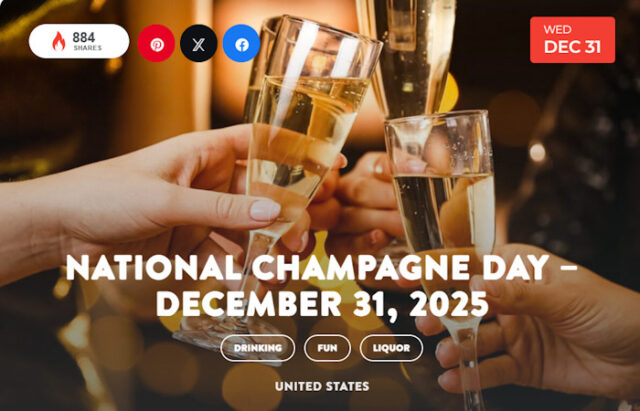
National Champagne Day, celebrated informally on December 31, is all about enjoying sipping on this bubbly beverage. It comes at a perfect time on New Year’s Eve, especially for champagne lovers, giving us an even better excuse to pop open a bottle — or two!
- 1890 BC – Christening ships started in Babylonia. They would pour liquid over the hull to check for holes, and this gradually turned into a ceremony using many different kinds of liquids and beverages.
- 5th Century – The Romans were the first to plant vineyards in this area of north-east France, with the region being cultivated by at least the 5th century, possibly earlier
- 987 – Hugh Capet is crowned King of France at Rheims Cathedral and starts the tradition of bringing successive monarchs to the Champagne region — the early wine of this region becomes a prominent display at coronation banquets.
- 1662 – Christopher Merritt documents the addition of fizz to wine. An English scientist, physicist, and naturalist, Merritt writes a paper noting that winemakers in England are adding sugar to wine to make it bubbly.
- 1697 – Contrary to popular belief, Dom Pérignon did not invent sparkling wine, though he did make significant contributions to the production and quality of sparkling Champagne wines.
- 1715 – Following the death of Louis XIV of France, the court of Philippe II made the sparkling version of champagne the drink of choice among the French aristocracy.
- 1891 – In an effort to maintain control over the use of their regional name, the French seek to limit the use of the name only to those sparkling wines that are actually produced in the Champagne region of France. This will eventually be affirmed by the Treaty of Versailles in 1919.
- 1900s – Champagne became the favorite to christen ships. Some would go to great lengths to make sure the bottle does in fact break every time.
- 1921 – Dom Perignon branding is introduced by Moët & Chandon. Initially produced from an aged version of their own vintage wines, the company will eventually produce the Dom Pérignon line as a unique bottling.
- 1960s – How did the tradition of Champagne showers in sports originate? The practice began at the 24 Hours of Le Mans in the 1960s, when a winning driver accidentally sprayed the crowd with Champagne, sparking a celebratory trend.
- 1988 – The longest recorded flight of a champagne cork is more than 177 feet (54 metres) at the Woodbury Winery, NY, on June 5, 1988. – Source
- 2000 – After some major setbacks in imports after the World Wars, Russian Revolution, and Prohibition during the 20th century, champagne once again becomes popular across the globe, with sales quadrupling.
- 2013 – Taste of Diamond champagne sells for $2.07 million. Also known as Gout de Diamants, this bottle boasts a label made of pure white gold that houses a pure Swarovski crystal and is recognized as the most expensive single bottle of champagne sold worldwide.
- In a 750ml bottle of Champagne, there are approximately 50 million bubbles.
- Marilyn Monroe took a bath in champagne. It took 350 bottles to fill up the tub.
- While many people think the martini was James Bond’s favorite drink, champagne has appeared in the Bond films more than 35 times, often revealing the Bollinger label.
- The pressure in a champagne bottle is 90 pounds per square inch. This is three times the amount of pressure as the tires on a car.
- Dropping a raisin into champagne causes it to travel continuously from the top of the glass to the bottom.
- There are currently 1 billion bottles of champagne in storage worldwide
- Champagne corks fly out at speeds near 25 mph
- The first sparkling Champagne was created accidentally; the pressure in the bottle led it to be called “the devil’s wine”, as bottles exploded or corks popped.
- Workers called “Riddlers” twist champagne bottles 1/8 of a turn every day to push the “lees” into the neck of the bottle. It’s a bizarre process that makes the champagne journey that much more complex for manufacturers.
- In its early production, Champagne bottles often exploded due to pressure from trapped carbon dioxide. This unpredictability led to the moniker “le vin du diable” or “the devil’s wine.”
- On average, 28,000 bottles of Champagne are served at Wimbledon each year.
- If you’re drinking good Champagne, you should see what’s called “collerette” – these are bubble trains on the sides of the glass.
- A somewhat surprising fact, perhaps, but marketing surveys have shown that concert-goers of hip-hop concerts, rap, and R&B gigs are 94% more likely to drink Champagne than the average person.
- Méthode Champenoise is the traditional method used to produce Champagne. After primary fermentation and bottling, a second alcoholic fermentation occurs in the bottle. This second fermentation is induced by adding several grams of yeast and rock sugar to the bottle.
- Sparkling wines and champagnes are generally categorized as: extra brut, brut, extra dry, sec, and demi sec. All of this depends on sugar levels. In wine terms, ‘dry’ is the opposite of sweet.
- Sabrage is a term for opening a champagne bottle with an actual sword. It’s only done in certain ceremonial occasions, and the wielder uses the blunt side of the sword. It was made famous by Napoleon and his army during victories in battle.
- Champagne can help prevent memory loss. According to research, one to three glasses of champagne each week could counteract memory loss associated with aging – so cheers!
Sources:

Disclaimer
Artificial Intelligence Disclosure & Legal Disclaimer
AI Content Policy.
To provide our readers with timely and comprehensive coverage, South Florida Reporter uses artificial intelligence (AI) to assist in producing certain articles and visual content.
Articles: AI may be used to assist in research, structural drafting, or data analysis. All AI-assisted text is reviewed and edited by our team to ensure accuracy and adherence to our editorial standards.
Images: Any imagery generated or significantly altered by AI is clearly marked with a disclaimer or watermark to distinguish it from traditional photography or editorial illustrations.
General Disclaimer
The information contained in South Florida Reporter is for general information purposes only.
South Florida Reporter assumes no responsibility for errors or omissions in the contents of the Service. In no event shall South Florida Reporter be liable for any special, direct, indirect, consequential, or incidental damages or any damages whatsoever, whether in an action of contract, negligence or other tort, arising out of or in connection with the use of the Service or the contents of the Service.
The Company reserves the right to make additions, deletions, or modifications to the contents of the Service at any time without prior notice. The Company does not warrant that the Service is free of viruses or other harmful components.