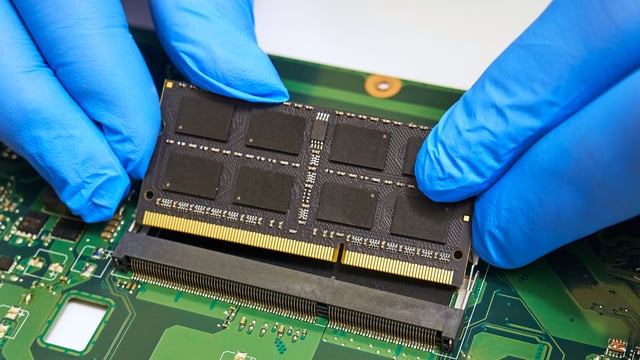
The global semiconductor market has hit a breaking point this month, leaving PC enthusiasts and casual buyers in a difficult position. A severe shortage of Dynamic Random Access Memory (RAM) has caused prices to skyrocket, with some DDR5 kits seeing a staggering 171% year-over-year increase. In response, major PC manufacturers and boutique system builders are taking a drastic step: encouraging consumers to “Bring Your Own” (BYO) RAM.
The AI Hunger for Silicon
The root cause of the shortage is the insatiable appetite of Artificial Intelligence. Leading chipmakers, including Samsung, SK Hynix, and Micron, have pivoted their production lines away from consumer-grade DDR4 and DDR5 memory to focus on High-Bandwidth Memory (HBM).
HBM is essential for the massive data centers powering LLMs (Large Language Models), but it requires three times the wafer capacity of standard memory. With OpenAI alone reportedly accounting for nearly 40% of global DRAM output, there simply isn’t enough silicon left to fill the slots in consumer laptops and desktops.

“Bring Your Own RAM”
The shortage has birthed a new trend in the PC industry. Smaller system integrators and laptop manufacturers, such as Framework and NovaCustom, have been the first to formalize a “barebones” approach. By selling systems without pre-installed RAM, manufacturers can keep the “sticker price” of a machine stable while offloading the sourcing burden—and the volatile costs—to the customer.
“The economics of pre-building have flipped,” says one industry analyst. “It is now cheaper for a manufacturer to ship a PC with empty slots than to compete with Microsoft or Google for the memory modules needed to fill them.”
Impact on Consumers
For the average buyer, this shift is jarring. Microsoft’s Copilot+ PCs now require a minimum of 16GB of RAM, yet many budget-tier manufacturers are considering a return to 4GB or 8GB configurations to save costs, despite the performance hit.
Industry experts suggest that if you find a high-quality RAM kit at a reasonable price, you should buy it immediately. With Micron recently announcing its exit from the Crucial consumer business to focus on enterprise clients, retail RAM availability is expected to remain tight through 2026.
As we head into the new year, the message from the industry is clear: if you want a high-performance machine, you might have to hunt down the memory yourself.
Sources:
- IDC: Global Memory Shortage Crisis: Market Analysis and Impact
- TechRadar: Why is RAM so expensive right now? It’s more complicated than you think
- Tom’s Hardware: AI data centers are swallowing the world’s memory supply
- MSI Blog: Memory Shortage 2025–2026: Causes and How to Build a PC
- TechPowerUp: Micron Forecasts DRAM Shortages Beyond 2026
Disclaimer
Artificial Intelligence Disclosure & Legal Disclaimer
AI Content Policy.
To provide our readers with timely and comprehensive coverage, South Florida Reporter uses artificial intelligence (AI) to assist in producing certain articles and visual content.
Articles: AI may be used to assist in research, structural drafting, or data analysis. All AI-assisted text is reviewed and edited by our team to ensure accuracy and adherence to our editorial standards.
Images: Any imagery generated or significantly altered by AI is clearly marked with a disclaimer or watermark to distinguish it from traditional photography or editorial illustrations.
General Disclaimer
The information contained in South Florida Reporter is for general information purposes only.
South Florida Reporter assumes no responsibility for errors or omissions in the contents of the Service. In no event shall South Florida Reporter be liable for any special, direct, indirect, consequential, or incidental damages or any damages whatsoever, whether in an action of contract, negligence or other tort, arising out of or in connection with the use of the Service or the contents of the Service.
The Company reserves the right to make additions, deletions, or modifications to the contents of the Service at any time without prior notice. The Company does not warrant that the Service is free of viruses or other harmful components.