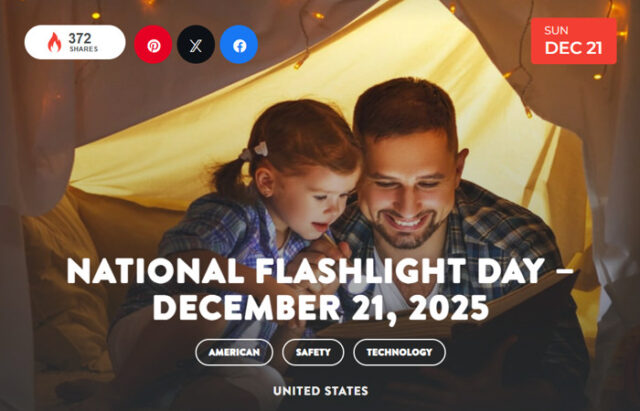
National Flashlight Day, on the same day as Winter Solstice, reminds us to turn on some lights during the shortest day of the year.
- Ancient Greeks discovered static electricity by rubbing fur on amber. The two materials together generated an attraction that released static energy. This led to the discovery of electricity as a natural resource.
- 1800 – Alessandro Volta created the first modern day battery. It was called the voltaic pile and was made up of zinc, copper, and vinegar. It was the first battery to provide a continuous flow of electricity, enabling scientists to use it in a controlled environment.
- Mid-1800s – The first electric lightbulb was invented. Historians often credit Humphry Davy with inventing the lightbulb; however, it wasn’t practical because it burned out too quickly.
- 1879 – Thomas Edison invented the first lightbulb to burn continuously for 13 hours.
- 1887 – the dry cell battery was invented by Carl Gassner. Unlike previous batteries, this one used an electrolyte paste rather than a liquid electrolyte.
- 1888 – Conrad Hubert founded the American Electrical Novelty and Manufacturing Company (later renamed Eveready). Hubert’s company manufactured and marketed battery-powered novelties.
- 1889 -The invention of the dry cell battery and miniature incandescent electric light bulbs made the first battery-powered flashlights possible.
- 1896 – The first mass-produced dry cell batteries started
- 1898 – The flashlight was invented in 1898 and patented in 1899. The biblical quote “let there be light” was on the cover of the 1899 Eveready catalog advertising the new flashlight.
- 1899 – British Inventor David Misell obtained U.S. Patent No. 617,592, assigned to American Electrical Novelty and Manufacturing Company. This device was powered by “D” batteries in a paper tube with a light bulb and a rough brass reflector at the end.
- 1926 – Eveready introduced the first flashlight that gave customers the flexibility to hang up their flashlights wherever they wanted.
- 1930s – Flashlights soar in popularity in China, with about 60 companies producing them.
- 1935 – William H. Byler invented the black light. Blacklight, or ultraviolet rays, are invisible to the human eye and require fluorescent colored items to emit a bright glow that we can see. The use of blacklight flashlights has helped discover hidden evidence at crime scenes and aided in anti-theft protection.
- 1966 – Thermoplastic molded flashlights were introduced.
- 1970s – The first rechargeable flashlight was introduced for emergency personnel.
- 1990s – the first LED flashlights were born as well, and they were way more efficient and durable than the conventional ones.
- 2020 – An eco-friendly flashlight made from recycled plastic bottles hit the market in 2020. It highlights sustainability while delivering reliable light.
- ‘Flashlights’ are also known as ‘torches’, which is a reference to the original flamed torches.
- LEDs can last anywhere between 12 to 22 years.
- Today the flashlights are mostly incandescent lamps or light-emitting diodes and run on disposable or rechargeable batteries.
- Flashlights come in many forms, from lipstick-shaped torches to ones designed like car keys. A Japanese company even made a flashlight that doubles as a portable phone charger.
- The Imalent MS18 is considered the world’s brightest flashlight. It produces 100,000 lumens, enough to light up entire stadiums or forests.
- Early filmmakers used handheld flashlights to simulate sunlight or moonlight in scenes before advanced lighting equipment existed. These devices gave directors more control over shadows and ambiance.
Sources:

Disclaimer
Artificial Intelligence Disclosure & Legal Disclaimer
AI Content Policy.
To provide our readers with timely and comprehensive coverage, South Florida Reporter uses artificial intelligence (AI) to assist in producing certain articles and visual content.
Articles: AI may be used to assist in research, structural drafting, or data analysis. All AI-assisted text is reviewed and edited by our team to ensure accuracy and adherence to our editorial standards.
Images: Any imagery generated or significantly altered by AI is clearly marked with a disclaimer or watermark to distinguish it from traditional photography or editorial illustrations.
General Disclaimer
The information contained in South Florida Reporter is for general information purposes only.
South Florida Reporter assumes no responsibility for errors or omissions in the contents of the Service. In no event shall South Florida Reporter be liable for any special, direct, indirect, consequential, or incidental damages or any damages whatsoever, whether in an action of contract, negligence or other tort, arising out of or in connection with the use of the Service or the contents of the Service.
The Company reserves the right to make additions, deletions, or modifications to the contents of the Service at any time without prior notice. The Company does not warrant that the Service is free of viruses or other harmful components.