WASHINGTON — A fierce political battle has erupted over the future of American currency as the Trump administration moves forward with plans to feature the president’s image on a new $1 coin. The proposal, intended to commemorate the 250th anniversary of the United States in 2026, has ignited a firestorm in Congress, where Democrats are moving to block what they characterize as a “monarchical” shift in American tradition.
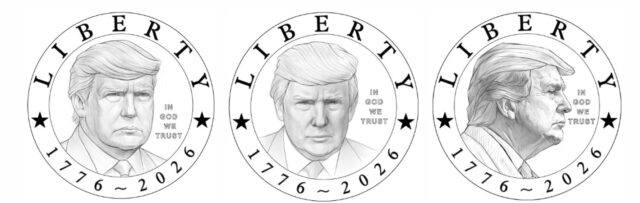
The Treasury Department recently unveiled draft designs for the “Semiquincentennial” dollar coin, featuring various portraits of President Donald J. Trump. One prominent design depicts the president with a raised fist—a reference to his survival of an assassination attempt in 2024—accompanied by the words “Fight, Fight, Fight.” Another draft shows a stern profile of the president beneath the word “Liberty.”
U.S. Treasurer Brandon Beach defended the designs, stating that the administration seeks to honor U.S. history and deliver “prosperity and patriotism” to the American people. However, the move has broken decades of precedent. Historically, the United States has avoided placing living individuals, especially sitting presidents, on its currency to distinguish the republic from European monarchies.

In response, Senators Catherine Cortez Masto (D-Nev.) and Jeff Merkley (D-Ore.) introduced the “Change Corruption Act” this week. The 14-word bill would explicitly prohibit the federal government from minting any currency that bears the likeness of a living or sitting president.
“We are not a country where we have had sitting presidents put their face on a $1 coin,” Senator Cortez Masto told Quartz. “We’re not a monarchy.”
The controversy over the $1 coin coincides with broader changes to the nation’s physical money. The Trump administration has already moved to scrap several planned “America 250” quarter designs that were set to honor the abolition of slavery, women’s suffrage, and the civil rights movement. Those designs, approved during the previous administration, featured figures like Frederick Douglass and Ruby Bridges.
Treasury Secretary Scott Bessent, who has the final say over coin designs, has replaced those themes with more traditional historical imagery, including the Mayflower Compact, the Revolutionary War, and the Gettysburg Address. Critics argue this shift represents a “whiter” and more exclusionary interpretation of American history, while supporters claim it restores a focus on foundational patriotic milestones.
The legal battle hinges on the Circulating Collectible Coin Redesign Act of 2020. While the law generally prohibits portraits of living persons on the reverse (tails) side of coins, it does not explicitly ban them from the obverse (heads) side of certain commemorative series. However, a longstanding custom dating back to the late 18th century has kept living presidents off legal tender.
As the 2026 deadline approaches, the Treasury continues to emphasize the “patriotic tone” of its new currency initiatives. Meanwhile, some Republican allies have proposed even more radical changes, including a $250 bill featuring Trump’s face. For now, the focus remains on the $1 coin, which serves as the latest front in the nation’s ongoing culture war.
Sources and Links:
- Quartz: Washington fights about what America’s money actually looks like
- Fox News: See the Biden-era ‘DEI’ coins Bessent scrapped
- Poynter: Trump wants his face on a US dollar coin. History, not law, stands in the way
- Senator Catherine Cortez Masto Press Release
Disclaimer
Artificial Intelligence Disclosure & Legal Disclaimer
AI Content Policy.
To provide our readers with timely and comprehensive coverage, South Florida Reporter uses artificial intelligence (AI) to assist in producing certain articles and visual content.
Articles: AI may be used to assist in research, structural drafting, or data analysis. All AI-assisted text is reviewed and edited by our team to ensure accuracy and adherence to our editorial standards.
Images: Any imagery generated or significantly altered by AI is clearly marked with a disclaimer or watermark to distinguish it from traditional photography or editorial illustrations.
General Disclaimer
The information contained in South Florida Reporter is for general information purposes only.
South Florida Reporter assumes no responsibility for errors or omissions in the contents of the Service. In no event shall South Florida Reporter be liable for any special, direct, indirect, consequential, or incidental damages or any damages whatsoever, whether in an action of contract, negligence or other tort, arising out of or in connection with the use of the Service or the contents of the Service.
The Company reserves the right to make additions, deletions, or modifications to the contents of the Service at any time without prior notice. The Company does not warrant that the Service is free of viruses or other harmful components.