Written by Mandy French — Fact checked by Jill Seladi-Schulman, Ph.D.
A large new study published in Neurology, the medical journal of the American Academy of Neurology, found that eating more high-fat cheese and high-fat cream may have a connection to a lower risk of developing dementia.
However, it is important to note that the study does not prove that eating high fat cheese and cream lowers the risk of dementia. It only shows an association.
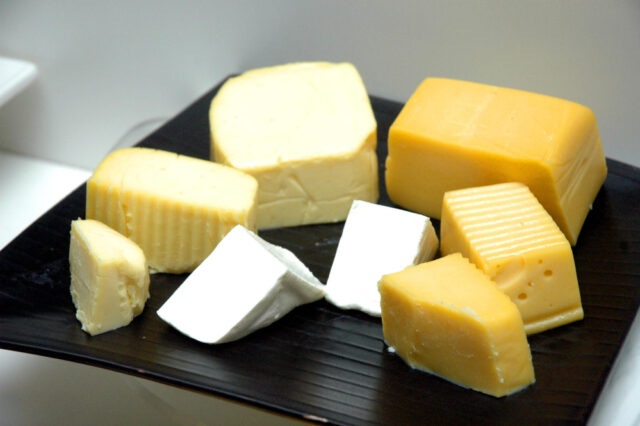
High-fat cheeses are those that contain more than 20% fat, such as cheddar, Brie, and Gouda. High-fat creams contain more than 30% to 40% fat, and include whipping cream, double cream, and clotted cream.

They may be shown as “full-fat” or “regular” in the store.
Emily Sonestedt, PhD, from Lund University in Sweden and one of the study researchers, told Medical News Today:
“Our study suggests that people who ate more high-fat cheese had a slightly lower risk of developing dementia later in life. This does not prove that cheese prevents dementia, but it challenges the idea that all high fat dairy is bad for the brain.”
Michelle Routhenstein, MS RD CDCES CDN, preventive cardiology dietitian at Entirely Nourished, who was not involved in the study, told us that “the finding that high fat cheese and cream may be associated with lower dementia risk is intriguing but not entirely surprising.“
“It challenges the old ‘low‑fat at all costs’ paradigm, yet aligns with growing evidence that dairy fat is often neutral or modestly protective, especially when fermented,” said Routhenstein.
“Importantly, the benefit appears largely when cheese replaces processed or high fat red meats, emphasizing the role of substitutions rather than suggesting that high‑fat dairy is inherently neuroprotective,” she added.
Sonestedt noted that many dementia cases involve damage to small blood vessels in the brain. This means that factors that support vascular health are also relevant for brain health.
“In our earlier work in the same Swedish cohort, we found that cheese — especially in moderate amounts — was linked to lower risk of cardiovascular disease. Large international studies, including those from the U.S., have shown similar results or at least neutral associations for cheese and heart health,” she added.
She went on to say that since there is an overlap between vascular and brain health, it made sense for them to continue their research and examine whether cheese might also be related to dementia risk.
The researchers analyzed data from 27,670 people in Sweden for the study. Participants had an average age of 58 years at the start of the study. They were followed for an average of 25 years. During the course of the study, 3,208 people developed dementia.
The study participants kept track of their food intake for a week and then answered questions about how often they consumed certain foods over the past year, as well as how they prepared their meals.
The researchers compared those who ate 50 grams (g) or more of high-fat cheese each day to people who ate less than 15 g each day.
Fifty grams of cheese amount to about 2 slices of cheddar cheese or half a cup of shredded cheese. This is approximately 1.8 ounces (oz). A typical serving is about 1 oz.
Of the group who ate more high-fat cheese, 10% developed dementia by the end of the study, whereas in the group that ate less 13% of participants developed dementia.
The researchers then adjusted for confounding factors, such as age, sex, education, and overall diet quality.
After these adjustments, they found that people who ate higher amounts of high-fat cheese had a 13% lower risk of developing dementia than those who ate less.
When they examined specific types of dementia, they found that the group that ate more high-fat cheese had a 29% lower risk of developing vascular dementia.
The study also found a lower risk of Alzheimer’s disease among those who ate more high fat cheese. However, this was only among those who did not carry the APOE e4 gene, which is linked to a predisposition for Alzheimer’s disease.
Sonestedt told MNT:
“Cheese is not just saturated fat. It is a fermented food with a unique combination of fats, proteins, minerals, and vitamins, including vitamin K2 in some varieties. Fermentation also produces bioactive peptides that may influence vascular and metabolic pathways relevant to brain health.”
The study researchers also examined individuals who consumed 20 g or more of high-fat cream each day. This is the equivalent of approximately 1.4 tablespoons or more of whipping cream.
The recommended serving size is approximately 1 to 2 tablespoons. They compared this group to those who didn’t consume any.
The researchers then made similar adjustments as they did for the cheese. They found that those who consumed high-fat cream had a 16% lower chance of developing dementia compared to those who consumed none.
There was no association found for dementia risk and consuming:
- low-fat cheese
- low-fat cream
- high- and low-fat milk
- butter
- fermented milk, including kefir and buttermilk.
“It’s also important to note that high-fat cheese was the type people actually ate in Sweden in the early 1990s. Low-fat cheese was much less common and eaten in smaller, irregular amounts, making it harder to study. The lack of association for low fat cheese may simply reflect limited intake data,” said Sonestedt.
She added that those who ate more high fat cheese tended to have an overall healthier profile.
“We adjusted for these differences, but in observational research, we can never fully separate a food from the lifestyle around it. So high-fat cheese may be part of a broader healthy eating pattern in this population. More studies are needed in other settings to understand whether cheese itself plays a protective role,” she cautioned.
Routhenstein noted that “more robust research focuses on overall dietary patterns for brain health, specifically plant-forward diets like Mediterranean, DASH, and MIND, rich in vegetables, fruits, legumes, whole grains, nuts, and healthy fats with modest fish and limited processed foods.”
“Specific foods such as leafy greens, berries, legumes, nuts, olive oil, and fatty fish have the strongest support, while cheese can occasionally replace less healthy proteins,” she added.
One of the most notable aspects of this new study, according to Sonestedt, is that:
“For many years, people were advised to limit high-fat dairy, and cheese was even placed in the ‘foods to avoid’ category in the MIND diet. Our findings — together with other studies — suggest that high fat cheese, eaten in moderate amounts, does not appear to harm brain health.”
The researcher also noted that it is important to remember that diets work as a whole. What you eat instead of cheese also matters.
There were some limitations to this study.
One limitation was that all the participants were from Sweden, which means the results may not be the same in other populations.
“These findings suggest that moderate amounts of cheese can fit into a healthy diet without raising dementia risk, but we are not recommending that people increase their cheese intake. More studies in other countries are needed to confirm these results,” said Sonestedt.
Sonestedt noted in a press release that cheese in Sweden is often eaten uncooked, whereas, in the United States, cheese is often eaten with meat or heated.
She pointed out that this is one reason it is important for future studies to be conducted in the U.S.
“In practice, the message is that no single food can protect your brain on its own, smart substitutions and overall brain‑healthy dietary patterns matter most. High‑fat cheese is not a brain superfood, but in context, it may be a relatively better choice than processed meats,” stated Routhenstein.
Disclaimer
Artificial Intelligence Disclosure & Legal Disclaimer
AI Content Policy.
To provide our readers with timely and comprehensive coverage, South Florida Reporter uses artificial intelligence (AI) to assist in producing certain articles and visual content.
Articles: AI may be used to assist in research, structural drafting, or data analysis. All AI-assisted text is reviewed and edited by our team to ensure accuracy and adherence to our editorial standards.
Images: Any imagery generated or significantly altered by AI is clearly marked with a disclaimer or watermark to distinguish it from traditional photography or editorial illustrations.
General Disclaimer
The information contained in South Florida Reporter is for general information purposes only.
South Florida Reporter assumes no responsibility for errors or omissions in the contents of the Service. In no event shall South Florida Reporter be liable for any special, direct, indirect, consequential, or incidental damages or any damages whatsoever, whether in an action of contract, negligence or other tort, arising out of or in connection with the use of the Service or the contents of the Service.
The Company reserves the right to make additions, deletions, or modifications to the contents of the Service at any time without prior notice. The Company does not warrant that the Service is free of viruses or other harmful components.