Hershey Rings in the Holidays with Interactive “Bells” Campaign
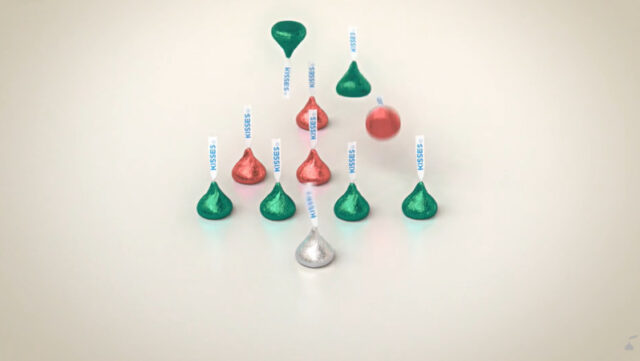
The Hershey Company has successfully modernized its longest-running and most beloved creative asset—the 1989 “Holiday Bells” commercial—by transforming the classic 15-second spot into a 360-degree interactive experience. Instead of relying solely on traditional ad buys, Hershey paired the return of its stop-motion animated Hershey’s Kisses, which ring out the tune of “We Wish You a Merry Christmas,” with a major multichannel campaign centered around the iconic Rockefeller Center Christmas tree lighting in New York City. The strategy, according to MarketDive, aims to connect with a contemporary audience by encouraging participation and content generation, recognizing that modern consumers are not limited to watching TV.
Central to the snack company’s holiday effort is an LED-powered musical mat installed at Rockefeller Center, which invited consumers to physically recreate the “Holiday Bells” ad. Running through the first week of December, the installation allowed visitors to step on the mat and make music, similar to the oversized keyboard from the movie Big or a game of Dance Dance Revolution. This physical activation shifts the focus from passive viewing to active engagement, generating shareable memories and content. As Vinny Rinaldi, vice president of consumer connections at Hershey, explained, the activation allows people to “engage, to capture their own content, to share and post.”
Beyond the physical space, the campaign leverages a comprehensive digital ecosystem. Consumers engaging with the mat have an opportunity to generate content, which is then amplified by local influencers. The brand also rolled out specific activations across major social and digital channels, including branded effects on TikTok and Snapchat, a SiriusXM home screen integration, and a rewards-based experience within the mobile game Candy Crush. Furthermore, the campaign includes a music video featuring country music star Lainey Wilson, highlighting how the brand is embracing various forms of content—video, audio, and social media—to reach consumers across demographics.

The original spot, born of a spontaneous idea in 1989, features only animated Kisses and remains one of the most iconic holiday advertisements in American marketing history, a testament to its enduring charm and “simplicity,” according to Stacy Taffet, chief growth officer at Hershey. Rinaldi noted the goal was to take this “incredible asset that everybody knows is Hershey Kisses and Christmas” and bring it to life across digital platforms, social media, and music, acknowledging that a 360-degree view is necessary since “not everybody’s watching just the TV commercial.”
This content-first approach reflects a broader industry shift, focusing on great ideas that reach consumers across demographics and channels. By pivoting toward experiential marketing and content creation, Hershey is attempting to deepen consumer relationships. Rinaldi summarized the underlying marketing philosophy by asking: “How do we get people to spend more time with our brands when our brands are probably the most comfort-seeking, authentic products that are in almost everybody’s home?” The campaign’s success is a case study in turning every consumer touchpoint—from a 15-second TV spot to a musical mat and digital packaging—into a connected, resonant experience.
Disclaimer
Artificial Intelligence Disclosure & Legal Disclaimer
AI Content Policy.
To provide our readers with timely and comprehensive coverage, South Florida Reporter uses artificial intelligence (AI) to assist in producing certain articles and visual content.
Articles: AI may be used to assist in research, structural drafting, or data analysis. All AI-assisted text is reviewed and edited by our team to ensure accuracy and adherence to our editorial standards.
Images: Any imagery generated or significantly altered by AI is clearly marked with a disclaimer or watermark to distinguish it from traditional photography or editorial illustrations.
General Disclaimer
The information contained in South Florida Reporter is for general information purposes only.
South Florida Reporter assumes no responsibility for errors or omissions in the contents of the Service. In no event shall South Florida Reporter be liable for any special, direct, indirect, consequential, or incidental damages or any damages whatsoever, whether in an action of contract, negligence or other tort, arising out of or in connection with the use of the Service or the contents of the Service.
The Company reserves the right to make additions, deletions, or modifications to the contents of the Service at any time without prior notice. The Company does not warrant that the Service is free of viruses or other harmful components.