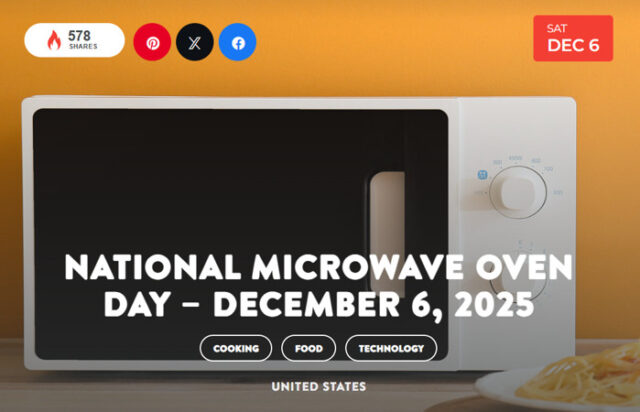
On December 6th, National Microwave Oven Day honors one appliance that changed the way we use the kitchen.
- 1945 – Quite by accident, self-taught American engineer Percy Spencer discovered a way to heat food safely with microwaves. While working with an active radar in 1945, he noticed a candy bar in his pocket was melting.
- 1945 – Raytheon filed a United States patent application for Spencer’s microwave cooking process on October 8, 1945.
- 1947 – Raytheon built the first commercially available microwave oven. It was called the “Radarange.”
- 1947 – The first public use of a microwave oven was in January 1947. The Speedy Weeny vending machine was placed in Grand Central Terminal, and it sold freshly prepared hot dogs.
- 1950 – On January 24, 1950, Raytheon Manufacturing Co. received patent no. US2495429A for “Method of treating foodstuffs.” The patent names Percy L. Spencer as the inventor.
- 1955 – The first domestic microwave oven is introduced
- 1955 – Raytheon outsourced its patents to Tappan, which launched a microwave that still wasn’t applicable for domestic use, and cost $1,295
- 1965 – Raytheon acquires Amana and produces the countertop microwave for $495 two years later.
- 1981 – It was Minnesota-based Golden Valley that first brought microwave popcorn to market.
- 1986 – around 25% of American households owned a microwave, and by 1997, that figure had climbed to 90%.
- 1999 – The National Inventors Hall of Fame inducted Percy Spencer in 1999.
- 2005 – National Microwave Oven Day was started in 2005 to honor the invention of the microwave oven and its impact on modern kitchens.
- Although the original microwave oven was perfect for quick snacks, it was intended for restaurant use and to reheat meals on airplanes.
- The high-powered microwave beams created a heating effect ideal for cooking.
- An estimated 90% of U.S. homes have a microwave.
- The first microwave was 6 feet tall and weighed over 750 pounds
- The first microwave sold for $5,000.
- The first food to be deliberately cooked with a microwave was popcorn
- A common idea that microwave ovens cook food “from the inside out” is a misconception.
- When heated in a microwave oven, closed containers like eggs can explode due to the increased pressure from steam that builds inside them.
- According to Spencer’s grandson, Rod, also an inventor, “The microwave oven eventually became known as Raytheon’s largest commercial failure, and the reason why was that, like so many other failures, they saw the cool technology, but they didn’t understand the market.”
- Microwaving plastic-covered food can give you cancer; standing next to it won’t.
- You can even use a microwave to remove labels from jars.
- Spinach retains virtually all its folate when cooked in a microwave and loses about 77% when cooked on a traditional stove.
- Amazon currently has over 3,800 microwave cookbooks on sale.
Sources:

Disclaimer
Artificial Intelligence Disclosure & Legal Disclaimer
AI Content Policy.
To provide our readers with timely and comprehensive coverage, South Florida Reporter uses artificial intelligence (AI) to assist in producing certain articles and visual content.
Articles: AI may be used to assist in research, structural drafting, or data analysis. All AI-assisted text is reviewed and edited by our team to ensure accuracy and adherence to our editorial standards.
Images: Any imagery generated or significantly altered by AI is clearly marked with a disclaimer or watermark to distinguish it from traditional photography or editorial illustrations.
General Disclaimer
The information contained in South Florida Reporter is for general information purposes only.
South Florida Reporter assumes no responsibility for errors or omissions in the contents of the Service. In no event shall South Florida Reporter be liable for any special, direct, indirect, consequential, or incidental damages or any damages whatsoever, whether in an action of contract, negligence or other tort, arising out of or in connection with the use of the Service or the contents of the Service.
The Company reserves the right to make additions, deletions, or modifications to the contents of the Service at any time without prior notice. The Company does not warrant that the Service is free of viruses or other harmful components.