TAMPA — Democrats and voting rights advocates this week voiced vehement opposition to Gov. Ron DeSantis’ call to redistrict Florida’s congressional map in a special session next year, calling it an “illegal” gerrymander in violation of the Florida Constitution.
Not surprisingly, DeSantis disagrees.

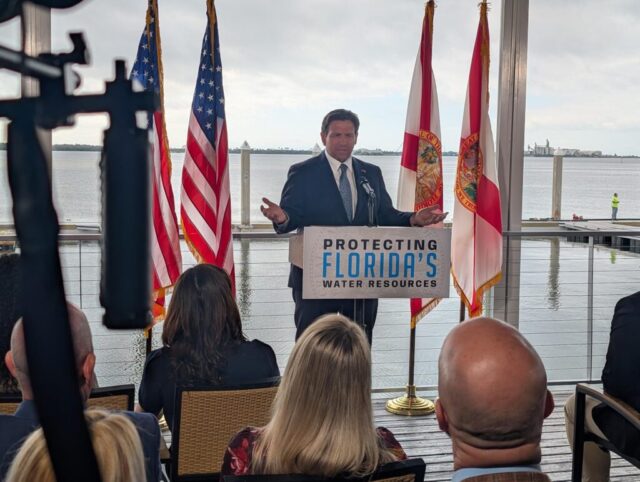
The governor was asked on Wednesday whether he feared a strong turnout for Democrats in the 2026 midterms could backfire on Republicans, creating a new map and actually putting more of the state’s 28 congressional districts in play.
“They’re not allowed to use the partisan data,” he said of the Legislature’s intent in creating a new congressional map for 2026.
The governor was alluding to a section of the Florida Fair District amendments passed by the voters in 2010 saying no reapportionment plan or individual district can be drawn “with the intent to favor or disfavor a political party or incumbent.”
Another section says districts cannot be drawn with the “intent or result of denying or abridging the equal opportunity of racial or language minorities to participate in the political process or to diminish their ability to elect representatives of their choice.”
In 2022, DeSantis vetoed the congressional map sent to him by the Republican-dominated Florida Legislature and reconfigured a district in North Florida to erase Black representation in that area and help elect more Republicans to Congress.
Voting rights groups sued in both state and federal court, claiming the map violated Fair Districts, but both lawsuits were unsuccessful. The Florida Supreme Court upheld the DeSantis-approved map in July, writing that the old Congressional District 5 map likely was an illegal race-based gerrymander that violated federal equal-protection rights. A panel of federal judges also upheld the constitutionality of the 2022 map a year ago.
Texas (and several other states around the country) undertook to redraw their congressional maps this year following a demand to do so by President Donald Trump in July.
1965 Voting Rights Act
DeSantis said his motivation for redrawing congressional districts is that the state will “be forced to do it because the Supreme Court’s VRA [Voting Rights Act] decision is going to impact the current map. No matter what else, that is going to have to be addressed.”
The U.S Supreme Court heard oral arguments in October in a case out of Louisiana that could lead to sweeping changes in longstanding rules requiring mapmakers to ensure that racial minorities get a chance to be an electoral majority or plurality in some areas.
The court is using the case to determine whether Section 2 of the Voting Rights Act remains constitutional. The section prohibits voting laws or procedures that deny or abridge voting rights due to a person’s “race or color” or membership in a language minority.
In July, the governor said it was “appropriate” for the state to conduct a mid-decade congressional redistricting because he contends Florida unfairly lost a seat to which it was entitled in the 2020 U.S. Census. He followed up on that in August, saying he and Attorney General James Uthmeier supported an update to the 2020 Census.
No update to U.S. Census
That hasn’t happened, however, and DeSantis acknowledged in Tampa Wednesday that it likely wouldn’t. He insisted it’s still appropriate to do the redistricting in Florida because the state’s political demographics have changed significantly since 2020, with Republicans surpassing Democrats in voter registration over the past five years (more than 1.4 million additional Republicans).
“I just haven’t seen the movement that I was hoping for,” he said about an updated Census.
“When did the Census stop? It stopped basically at the end of March of 2020. But what’s happened in Florida since then? We’ve had a big population [increase]. So, the districts are not well apportioned, and I don’t think that people are getting equal representation. And that was a demographic shift that I don’t know that we’ve necessarily seen in modern history before.”
DeSantis’ call for a special session on the topic following the regular legislative session would seem to fly in the face of efforts about to be undertaken by the Florida House, which will begin its own committee meetings on the issue Thursday afternoon.
The governor did not respond to the Phoenix’s question to him Wednesday as to whether his special session means the House’s work during the regular session may prove irrelevant.
Asked if his staff were already working on alternative congressional maps, he said no.
“There’s nothing that anyone on my staff has done with respect to actually doing the map,” he said.
Meanwhile, state Rep. Daryl Campbell, D-Fort Lauderdale, filed a resolution Wednesday (HJR 619) that attempts to end partisan gerrymandering once and for all. He would allow voters to decide via a constitutional amendment whether to create independent commissions (one each for the state House, state Senate, and Congress) to redraw legislative and congressional districts.
“The people should choose their representatives, not the other way around. These commissions would be made up of regular Floridians — not lawmakers, not lobbyists, not campaign insiders,” Campbell said in a press release. “If you’ve recently made money in politics, you’re out. This is about independence and fairness, not influence and favors.
Disclaimer
Artificial Intelligence Disclosure & Legal Disclaimer
AI Content Policy.
To provide our readers with timely and comprehensive coverage, South Florida Reporter uses artificial intelligence (AI) to assist in producing certain articles and visual content.
Articles: AI may be used to assist in research, structural drafting, or data analysis. All AI-assisted text is reviewed and edited by our team to ensure accuracy and adherence to our editorial standards.
Images: Any imagery generated or significantly altered by AI is clearly marked with a disclaimer or watermark to distinguish it from traditional photography or editorial illustrations.
General Disclaimer
The information contained in South Florida Reporter is for general information purposes only.
South Florida Reporter assumes no responsibility for errors or omissions in the contents of the Service. In no event shall South Florida Reporter be liable for any special, direct, indirect, consequential, or incidental damages or any damages whatsoever, whether in an action of contract, negligence or other tort, arising out of or in connection with the use of the Service or the contents of the Service.
The Company reserves the right to make additions, deletions, or modifications to the contents of the Service at any time without prior notice. The Company does not warrant that the Service is free of viruses or other harmful components.