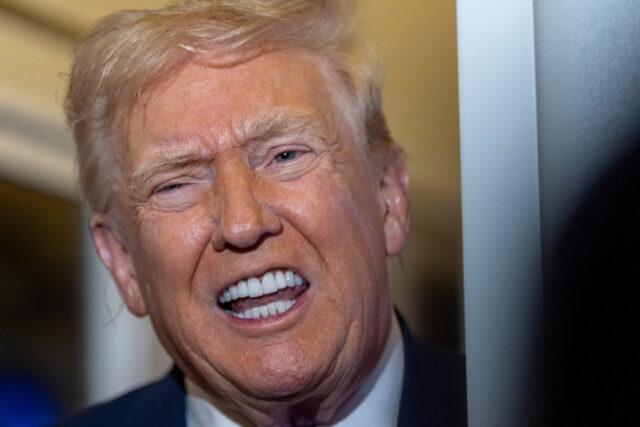
U.S. President Donald J. Trump declared on Tuesday that the United States will soon begin carrying out land‑based military strikes against suspected drug traffickers — a significant escalation of an already controversial campaign targeting smuggling vessels at sea.
Speaking at the White House, Trump said the U.S. military has focused on attacking drug‑smuggling boats in the Caribbean and Pacific, but “the land is much easier — and we know the routes they take.” He told senior officials the land strikes would commence “very soon.”
The announcement follows a series of maritime operations under a program dubbed Operation Southern Spear. Since September, U.S. forces have launched at least 19 strikes on suspected trafficking vessels, resulting in dozens of deaths, according to recent reporting.
The administration is justifying the expansion to land operations as necessary because sea‑based trafficking has reportedly dropped — forcing cartels to shift to overland routes. Trump said the land-based campaign could target not only Venezuela but any country he deems complicit in trafficking drugs into the United States.

Critics, however, are raising serious legal and ethical concerns. Some U.S. lawmakers — both Democrats and Republicans — along with former military lawyers, argue that the use of lethal force in this context may violate both U.S. law and international law. The concern is especially acute given recent reporting that a follow‑up boat strike ordered by a U.S. admiral killed survivors clinging to wreckage.
A legal opinion from the U.S. Department of Justice’s Office of Legal Counsel (OLC) reportedly underpins the campaign, framing the situation as a “non‑international armed conflict.” This designation allows — in theory — the U.S. to use lethal force under the law of armed conflict. But experts say the evidence for such a conflict, and for the alleged cartels’ armed aggression, remains unsubstantiated.
For now, Trump’s announcement has drawn sharp reactions from Latin American governments. Some view the move as an aggressive intervention likely to destabilize long‑fragile regional relations, and warn it could be a precursor to broader military involvement beyond drug interdiction.
As the situation develops, all eyes will be on where — and when — the first land strikes occur, and whether Congress or international bodies respond to mounting concerns about legality, sovereignty, and human rights.
Sources
Disclaimer
Artificial Intelligence Disclosure & Legal Disclaimer
AI Content Policy.
To provide our readers with timely and comprehensive coverage, South Florida Reporter uses artificial intelligence (AI) to assist in producing certain articles and visual content.
Articles: AI may be used to assist in research, structural drafting, or data analysis. All AI-assisted text is reviewed and edited by our team to ensure accuracy and adherence to our editorial standards.
Images: Any imagery generated or significantly altered by AI is clearly marked with a disclaimer or watermark to distinguish it from traditional photography or editorial illustrations.
General Disclaimer
The information contained in South Florida Reporter is for general information purposes only.
South Florida Reporter assumes no responsibility for errors or omissions in the contents of the Service. In no event shall South Florida Reporter be liable for any special, direct, indirect, consequential, or incidental damages or any damages whatsoever, whether in an action of contract, negligence or other tort, arising out of or in connection with the use of the Service or the contents of the Service.
The Company reserves the right to make additions, deletions, or modifications to the contents of the Service at any time without prior notice. The Company does not warrant that the Service is free of viruses or other harmful components.