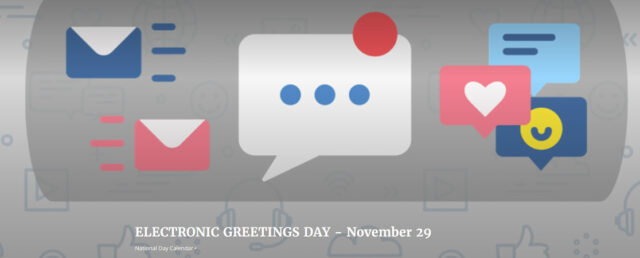
Electronic Greetings Day is on November 29, and we celebrate by sending e-cards to everyone on our contact list who we haven’t chatted with in a while. Can you imagine that only 5% of Americans were on social media in 2005? E-cards, also known as electronic cards, are digital greeting cards or postcards created using digital media.
- 1800s – Greeting cards were initially unsophisticated and mostly featured explicit messages written on wood, paper, and other materials.
- 1869 – Picture postcards started the evolution of greeting card designs. They were first used in Austria and were dated back to 1869.
- 1910 – The brothers who later founded Hallmark created the folded greeting card.
- 1930s – Saw a massive change in greeting card designs, with the innovation of interactive greeting cards. Hall Brothers, a favorite greeting card manufacturer at the time, designed cards using the die-cut technique. In addition to images, these cards featured movable parts such as rotating wheels on a greeting card with a picture of a car.
- 1960 – The University of Illinois developed PLATO (computer-assisted instruction system).
- 1960s – Photographic greeting cards came into the picture.
- 1970s – The ARPANET evolved into the Internet following the publication of the first T.C.P. (Transmission Control Protocol)
- 1994 – Judith Donath created the first electronic greeting card site in 1994 at the MIT Media Lab. It was called the Electric Postcard.
- 1997 – SixDegrees launch introduces features that let you create a real profile and connect with people online.
- 2007 – A wave of emails with the subject “You’ve received a postcard from a family member!” and links to exploitive malware sites.
- 21st Century – The launch of social sites like Facebook, MySpace, Twitter, and LinkedIn.
- 2020 – E-cards became more popular than ever. The 2020 pandemic highlighted the need for people to find new ways to connect in isolation and over long distances.
- The convenience and speed of sending an electronic greeting allow more people than ever to participate in this thoughtful process. We all enjoy it when someone remembers our birthdays, anniversaries, and other important life events.
- While greeting cards remain popular, electronic greetings are far more cost-effective and just as meaningful.
- These days, things like Facebook stickers and other electronic greetings dominate the field, but the concept remains essentially unchanged.
- These days, social media slideshows and video cards have replaced most E-cards, but electronic greeting card sites aren’t dead. If you want a blast from the past, use Electronic Greetings Day to check out modern E-cards. They’re higher resolution now, and many still have the classic cheese-factor as the E-cards of yore.
- The most popular Everyday card-sending occasion by far is a Birthday, followed by a number of secondary occasions, including Sympathy, Thank You, Wedding, Thinking of You, Get Well, New Baby, and Congratulations.
• The most popular Seasonal cards are Christmas cards, with some 1.6 billion units purchased (including boxed cards).- This is followed by cards for Valentine’s Day (145 million units, not including classroom valentines),
- Mother’s Day (133 million units),
- Father’s Day (90 million units),
- Graduation (67 million units),
- Easter (57 million units), Halloween (21
million units), - Thanksgiving (15 million units)
- St. Patrick’s Day (7 million units).
• Galentine’s Day, celebrated on February 13, has increased in popularity for the last several years as women are celebrating their female friendships the day before Valentine’s Day, aka…Galentine’s Day!
- Women purchase an estimated 80% of all greeting cards. Women spend more time choosing a card than men and are more likely to buy several cards at once.
- Seven out of 10 card buyers surveyed consider greeting cards “absolutely” or “almost” essential to them. Eight out of 10 of these buyers expect their purchases to remain the same in the future.
- Of the balance, twice as many card buyers say they will “increase” their purchasing as they will “decrease” their purchasing in the coming year.
• Younger card buyers and those who are more technology savvy are currently the ones most engaged in buying paper greeting cards online.
• Most people now acknowledge many more birthdays than ever before because of social media, but they aren’t necessarily sending fewer cards as a result.
• The tradition of giving greeting cards as a meaningful expression of personal affection for another person is still being deeply ingrained in today’s youth, and this tradition will likely continue as they become adults and become responsible for managing their own meaningful relationships. - They are eco-friendly because they are created digitally and sent electronically, so no paper is used.
Sources:

Disclaimer
Artificial Intelligence Disclosure & Legal Disclaimer
AI Content Policy.
To provide our readers with timely and comprehensive coverage, South Florida Reporter uses artificial intelligence (AI) to assist in producing certain articles and visual content.
Articles: AI may be used to assist in research, structural drafting, or data analysis. All AI-assisted text is reviewed and edited by our team to ensure accuracy and adherence to our editorial standards.
Images: Any imagery generated or significantly altered by AI is clearly marked with a disclaimer or watermark to distinguish it from traditional photography or editorial illustrations.
General Disclaimer
The information contained in South Florida Reporter is for general information purposes only.
South Florida Reporter assumes no responsibility for errors or omissions in the contents of the Service. In no event shall South Florida Reporter be liable for any special, direct, indirect, consequential, or incidental damages or any damages whatsoever, whether in an action of contract, negligence or other tort, arising out of or in connection with the use of the Service or the contents of the Service.
The Company reserves the right to make additions, deletions, or modifications to the contents of the Service at any time without prior notice. The Company does not warrant that the Service is free of viruses or other harmful components.