alary transparency laws don’t just make the job hunt a little less frustrating. New research shows they also help raise wages across the board.
In a growing number of states, new rules require employers to disclose a good-faith pay range on job listings. The changes come with the added benefit of lifting wages by up to 3.6% for workers, according to a working paper released Monday by the National Bureau of Economic Research, or NBER.
“We find that pay transparency in job postings successfully leads to higher average wages,” economist David Arnold, lead author of the report, tells Money in an email.


The researchers discovered the pay bump by analyzing job listings in Colorado aggregated from thousands of websites before and after a watershed 2021 salary transparency law took effect in the state. They found that disclosed salaries represented a 3.6% increase relative to pay before the law was enacted. Actual earned salaries increased by 1.3%, according to self-reported salary data on Glassdoor and wages published by the U.S. Department of Labor.
When looking at Labor Department data in other states following 2021, the researchers similarly found a 1.3% increase in wages as a result of disclosure laws.
What’s more, “this positive wage effect appears for both incumbent workers and new hires,” the NBER researchers wrote, “indicating that the policy impacts workers not directly targeted by the law.”
This analysis confirms that salary transparency, a recent workplace trend in the U.S., can help raise wages in several ways, like by helping new hires secure competitive pay, informing current workers whether they’re being underpaid and spurring wage competition among employers.
“The finding that wages tend to go up is quite distinct from past work,” Arnold says. “We provide suggestive evidence that pay transparency is an effective way to get firms to compete for workers, therefore bidding up wages.”
The NBER study also found that transparency laws increase the amount of job listings with posted salary ranges by 30 percentage points, though the researchers noted that many listings for high-paying roles still don’t include pay.
A separate study by the Federal Reserve Bank of New York found much the same. Following the enactment of salary transparency laws, pay ranges in job listings spiked in Colorado, New York City, California and Washington. However, in all cases, the NY Fed determined that compliance typically tops out at around 75%, meaning that about a quarter of job listings don’t disclose pay even when they’re supposed to.
Which states have pay transparency laws?
Many areas across the country are following in Colorado’s footsteps by enacting legislation that requires more pay transparency from employers.
More than a dozen new pay disclosure laws have gone into effect since 2021. Many of the rules are statewide, though a handful of municipalities have made similar changes.
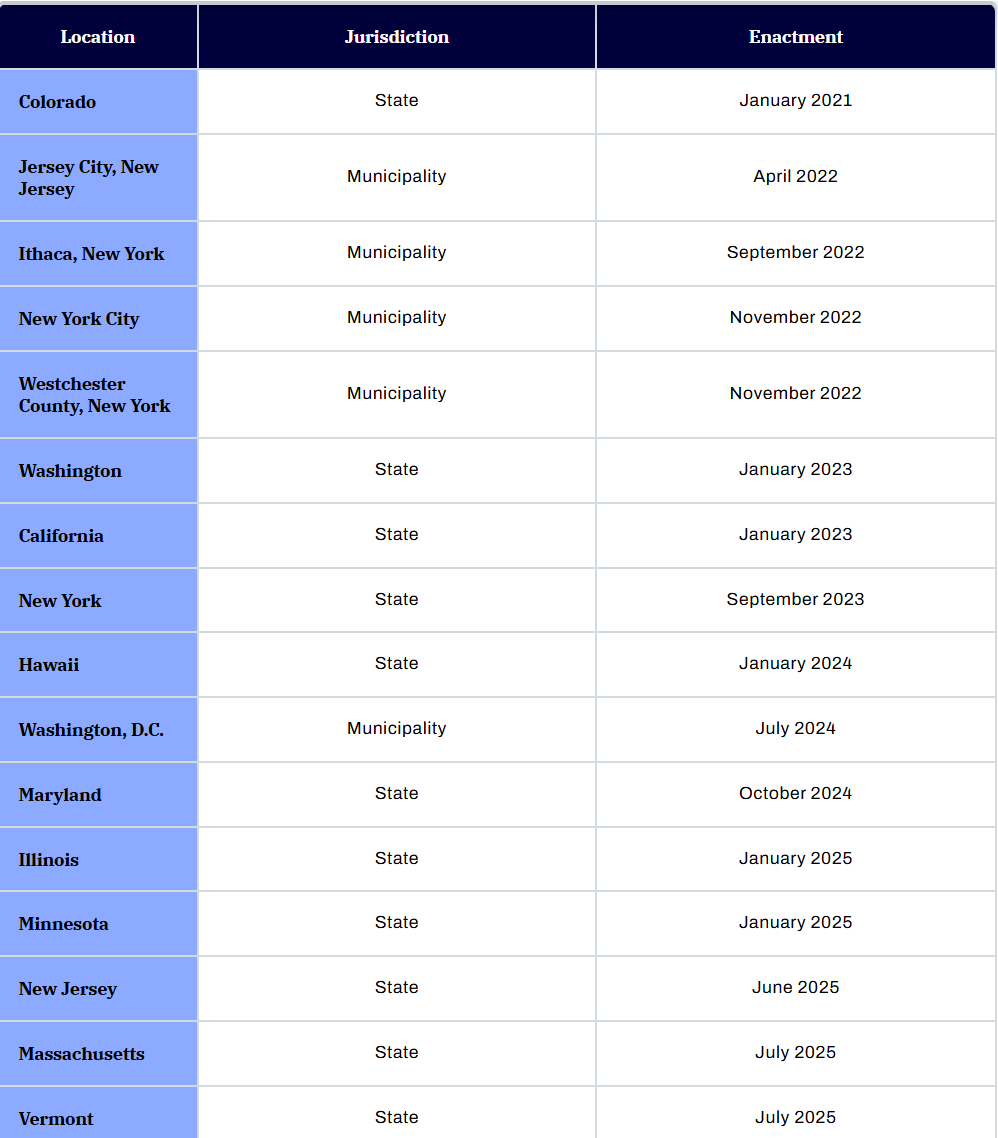
Research shows these pay transparency laws tend to have a ripple effect. The NBER paper is among the first to indicate that salary transparency can help raise the wages of all workers. And the NY Fed says over two-thirds of all U.S. job postings now include salary information — a threefold increase from 2018.
In addition, the NBER study found there is little to no downside of the new laws. The analysts determined there was no indication that the rules adversely affect pay differences within companies, employment levels, the number of job listings or the educational requirements for new job postings.
“Pay transparency laws seem to be a relatively low-cost way to increase average wages,” Arnold says.
Disclaimer
Artificial Intelligence Disclosure & Legal Disclaimer
AI Content Policy.
To provide our readers with timely and comprehensive coverage, South Florida Reporter uses artificial intelligence (AI) to assist in producing certain articles and visual content.
Articles: AI may be used to assist in research, structural drafting, or data analysis. All AI-assisted text is reviewed and edited by our team to ensure accuracy and adherence to our editorial standards.
Images: Any imagery generated or significantly altered by AI is clearly marked with a disclaimer or watermark to distinguish it from traditional photography or editorial illustrations.
General Disclaimer
The information contained in South Florida Reporter is for general information purposes only.
South Florida Reporter assumes no responsibility for errors or omissions in the contents of the Service. In no event shall South Florida Reporter be liable for any special, direct, indirect, consequential, or incidental damages or any damages whatsoever, whether in an action of contract, negligence or other tort, arising out of or in connection with the use of the Service or the contents of the Service.
The Company reserves the right to make additions, deletions, or modifications to the contents of the Service at any time without prior notice. The Company does not warrant that the Service is free of viruses or other harmful components.