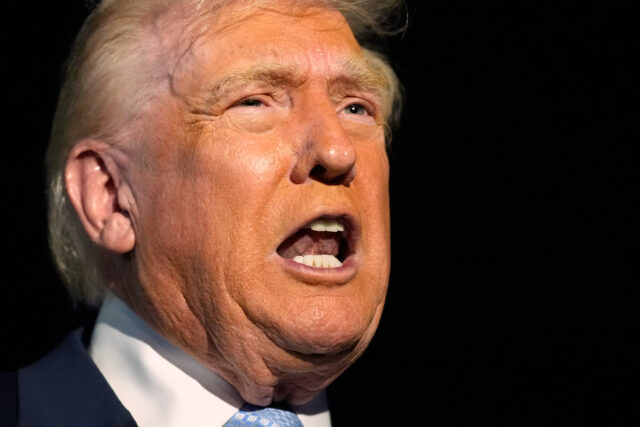
President Donald Trump this week reaffirmed his narrative of fiscal strength and economic revival, even as mounting evidence suggests many Americans feel otherwise. At a gathering of franchise owners and suppliers of McDonald’s in Washington, he said his administration was “fighting every day” to lower costs, and touted the economy as “the greatest we’ve ever had.”
On Monday, Trump addressed McDonald’s stakeholders, drawing on his campaign-style rhetoric and referencing the fast-food chain’s value-meal offerings as a barometer of affordability. He claimed the price of everyday goods is coming down under his watch, noting that his team has cut tariffs on more than 200 food items — including beef, bananas, and coffee — in what he framed as relief for long-suffering consumers.
Yet despite Trump’s persisting message of triumph, polling data and expert commentary underscore a gap between his portrayal of the economy and the lived experience of many voters. According to one survey, just 3 percent of respondents believe the economy is in “excellent” shape, while 40 percent describe it as “poor.” Inflation remains elevated: consumer prices rose about 3 percent year-on-year in September, and grocery prices were up roughly 2.7 percent.
Economists argue the U.S. is experiencing a “K-shaped” recovery: some households and sectors rebound strongly, while others — particularly lower‐income earners dealing with everyday price pressure — are stagnating or falling behind. In response, the Trump administration has floated more ambitious interventions: for example, Treasury Secretary Scott Bessent confirmed that a plan is under consideration to send $2,000 rebate checks to lower‐ and middle-income Americans, funded by increased tariff revenue, though implementation would require congressional approval.

Further complicating Trump’s economic messaging is the broader global fallout of his protectionist trade strategy. Data shows that economies such as those of Japan and Switzerland have contracted recently, signalling headwinds in global demand and ripple effects for U.S. exporters.
Back in Washington, the GOP is publicly maintaining that there is no “affordability crisis,” even in the face of state and local election losses, which analysts attribute in part to voter frustration with the costs of living. Party officials argue the solution lies in doubling down on the president’s economic agenda, not repositioning around those concerns.
For Trump, the immediate political task is to bridge the growing gap between what voters say they feel and what he claims they should feel. If affordability remains the top concern — as polls indicate — the optics of an economy touted as historically strong may ring hollow unless tangible relief reaches the kitchen table.
With more than a year until the next major electoral test, the administration appears to be adopting a dual track: continue promoting growth, tax cuts, and manufacturing reshoring, while also introducing headline relief measures like rebate checks and tariff roll-backs to respond to cost pressures. Whether that strategy proves sufficient remains to be seen.
Sources:
Disclaimer
Artificial Intelligence Disclosure & Legal Disclaimer
AI Content Policy.
To provide our readers with timely and comprehensive coverage, South Florida Reporter uses artificial intelligence (AI) to assist in producing certain articles and visual content.
Articles: AI may be used to assist in research, structural drafting, or data analysis. All AI-assisted text is reviewed and edited by our team to ensure accuracy and adherence to our editorial standards.
Images: Any imagery generated or significantly altered by AI is clearly marked with a disclaimer or watermark to distinguish it from traditional photography or editorial illustrations.
General Disclaimer
The information contained in South Florida Reporter is for general information purposes only.
South Florida Reporter assumes no responsibility for errors or omissions in the contents of the Service. In no event shall South Florida Reporter be liable for any special, direct, indirect, consequential, or incidental damages or any damages whatsoever, whether in an action of contract, negligence or other tort, arising out of or in connection with the use of the Service or the contents of the Service.
The Company reserves the right to make additions, deletions, or modifications to the contents of the Service at any time without prior notice. The Company does not warrant that the Service is free of viruses or other harmful components.