Americans really love sugar. The average American consumes 17 teaspoons of added sugar every day — that’s more than double the recommended daily allowance. According to the American Heart Association, this adds up to a whopping 60lb of added sugar per person annually.
Luckily for candy lovers (and manufacturers), our favorite sugary drinks are primarily responsible for our overconsumption of sugar. The average 20-ounce bottle of a sugar-sweetened beverage contains about 65 grams (0.14lbs) of added sugar, typically from high-fructose corn syrup. After sugar-sweetened beverages, Americans get most of their excess sugar from desserts and sweet snacks (such as cookies, brownies, cakes, pies, and ice cream). This doesn’t mean that candy is entirely off the hook; it still makes up almost 10% of our added sugar intake.
But that 10% is an average, which means there are Americans who eat far more and far less candy than others. And with Halloween fast approaching, we wanted to see which U.S. states have the biggest sweet tooth — and which candies stand out as the favorites (and most hated) across the country.
Key takeaways
- Nebraska claims this year’s candy crown as the state with the biggest sweet tooth, while the previous winner, Utah, fell all the way to fifth place.
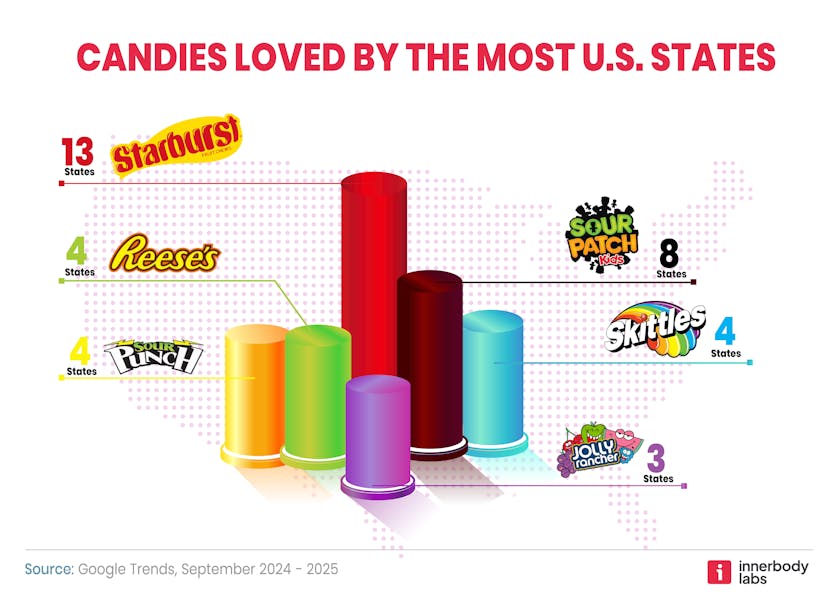
- America is bursting with joy for Starburst candy: it came out on top in an impressive 13 states. But lovers of Sour Patch Kids, don’t feel sour — your favorite came in second as the top treat in eight states.
- No treats, only tricks: the District of Columbia came in last for candy appreciation by total search volume. But it’s in Wyoming that the largest number of candy brands have zero search value. (Even Tootsie Rolls! What did Tootsie Rolls ever do to you, Wyoming?)
- Coincidentally, Kansas — known for its extensive corn production — is the only state to have candy corn as its favorite.
- Too hot to handle? Hot Tamales are among the least popular candies in 39 states (sorry, New Mexico, but you seem to be alone in loving this one).
America’s most and least liked candies: an overview
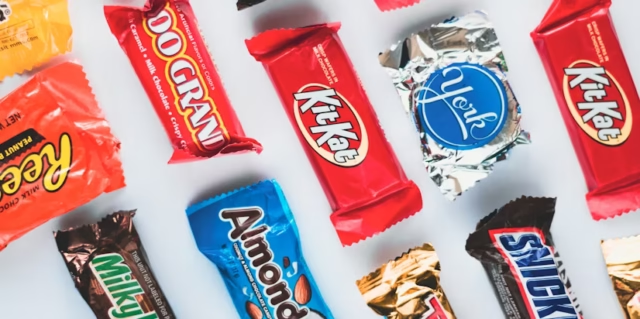
The U.S. confectionery market is worth $88.01 billion as of 2025,2 and it’s expected to grow by over 5% annually. Based on the country’s total population, this means that the average American spends over $250 every year on candy — that’s a lot of Kit Kats. Spending on candy also increases around the holidays, and Halloween gives a particularly large boost to companies’ profits. Compared to the $11.6 billion spent in 2024, experts estimate that Americans will spend $13.1 billion this year for Halloween, with candy purchases making up $3.9 billion of that.

Even though trick-or-treating has been a staple of American childhoods since the 1930s, the 1950s were when candy manufacturers began promoting products for Halloween. But it wasn’t until the 1970s that factory-made, wrapped candy became more widespread than the fruits, toys, and homemade baked goods that were traditionally given out.4 This was largely due to the fear that strangers could easily poison any Halloween treats they’d prepared themselves, whereas a factory-sealed candy would be harder to tamper with. Though there weren’t any actual Halloween poisonings (or razor blades hidden inside apples), the collective anxiety pushed mass-produced candy into the spotlight as a safe alternative — and it’s been that way ever since.
While the popularity of candy itself won’t be fading anytime soon, the love for different types of candy can evolve from year to year. So, as lovers of candy ourselves, we annually set out to discover what treats Americans are most interested in this Halloween season and which ones are considered worse than tricks.
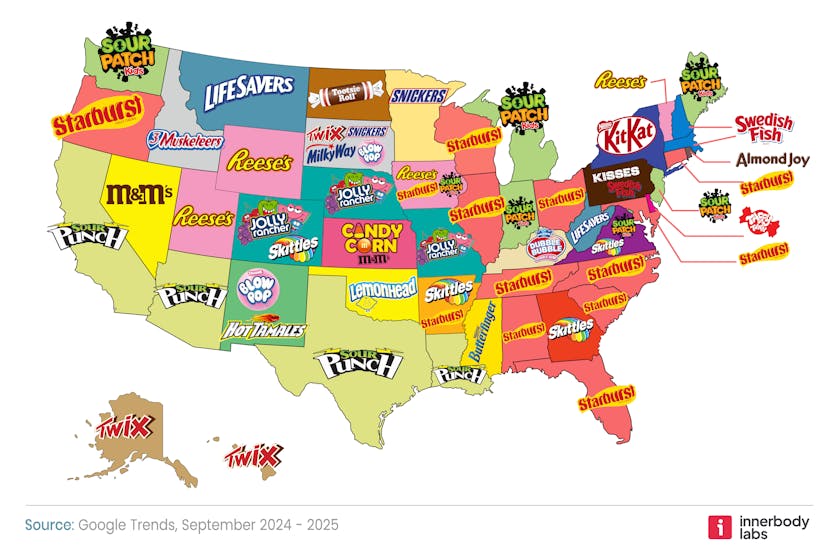
By analyzing the Google Trends search data of all 50 states and the District of Columbia, we were able to determine the top six most popular candy brands in America, plus how many places chose them as a favorite and which territories are home to their most devoted fans:
- Starburst (13): Alabama, Arkansas, Connecticut, District of Columbia, Florida, Illinois, Iowa, North Carolina, Ohio, Oregon, South Carolina, Tennessee, Wisconsin
- Sour Patch Kids (8): Indiana, Iowa, Maine, Maryland, Michigan, New Jersey, Virginia, Washington
- Reese’s (4): Iowa, Utah, Vermont, Wyoming
- Skittles (4): Arkansas, Georgia, Nebraska, Virginia
- Sour Punch Straws (4): Arizona, California, Louisiana, Texas
- Jolly Ranchers (3): Colorado, Missouri, Nebraska
Rounding out the top 10 favorite candy brands are Swedish Fish (3), Twix (3), Blow Pops (2), and Life Savers (2).
Americans, it seems, aren’t in a very chocolate-y mood this year; the only two chocolate-based candies in the top 10 are Reese’s and Twix. If anything, people may be feeling a bit sour, seeing as Sour Patch Kids and Sour Punch Straws both made the top six.
Some other interesting things to note about our favorite-candy findings:
- Pennsylvania is one of three states where Swedish Fish is a favorite. Between 1638 and 1655, a colony of the Swedish Empire — New Sweden — spanned parts of the Northeastern United States, including Pennsylvania. Perhaps this history left a lasting mark on the tastes of the Keystone State’s residents.
- Kansas stands alone in its love of candy corn, which seems appropriate since it’s one of the country’s top 10 corn-producing states.
- Colorado’s favorite candy, Jolly Ranchers, was first made there in 1949; similarly, Pennsylvania’s other favorite, the Hershey’s Kiss, was created in the state in 1907.
- For some reason, despite sharing a love for Blow Pops, New Mexico and South Dakota also have a mutual dislike of Dubble Bubble.
- The majority of the top 10 candy brands were first created outside of the United States.
If you’re curious about which candy came out on top in your state, here are our complete findings:
| States | Most popular candy |
|---|---|
| Alabama | Starburst |
| Alaska | Twix |
| Arizona | Sour Punch Straws |
| Arkansas | Skittles, Starburst |
| California | Sour Punch Straws |
| Colorado | Jolly Ranchers |
| Connecticut | Starburst |
| Delaware | Salt Water Taffy |
| District of Columbia | Starburst |
| Florida | Starburst |
| Georgia | Skittles |
| Hawaii | Twix |
| Idaho | 3 Musketeers |
| Illinois | Starburst |
| Indiana | Sour Patch Kids |
| Iowa | Reese’s, Sour Patch Kids, Starburst |
| Kansas | Candy Corn |
| Kentucky | Dubble Bubble |
| Louisiana | Sour Punch Straws |
| Maine | Sour Patch Kids |
| Maryland | Sour Patch Kids |
| Massachusetts | Swedish Fish |
| Michigan | Sour Patch Kids |
| Minnesota | Snickers |
| Mississippi | Butterfinger |
| Missouri | Jolly Ranchers |
| Montana | Life Savers |
| Nebraska | Jolly Ranchers, Skittles |
| Nevada | M&M’s |
| New Hampshire | Swedish Fish |
| New Jersey | Sour Patch Kids |
| New Mexico | Blow Pops, Hot Tamales |
| New York | Kit Kat |
| North Carolina | Starburst |
| North Dakota | Tootsie Roll |
| Ohio | Starburst |
| Oklahoma | Lemonheads |
| Oregon | Starburst |
| Pennsylvania | Hershey’s Kisses, Swedish Fish |
| Rhode Island | Almond Joy |
| South Carolina | Starburst |
| South Dakota | Blow Pops, Milky Way, Snickers, Twix |
| Tennessee | Starburst |
| Texas | Sour Punch Straws |
| Utah | Reese’s |
| Vermont | Reese’s |
| Virginia | Skittles, Sour Patch Kids |
| Washington | Sour Patch Kids |
| West Virginia | Life Savers |
| Wisconsin | Starburst |
| Wyoming | Reese’s |
The least popular candy in the U.S.
Previously, the overall top candy brand was Blow Pops, but its popularity bubble has seemingly burst. This year, only two states chose it as a favorite, while 12 others see it as one of the worst. But it’s still far from the least popular candy brand in the United States — that would be Hot Tamales.
In 1999, Hot Tamales was the top-selling cinnamon candy. But now, with its search popularity being notably low in 39 states, America has seemingly dropped Hot Tamales like a hot potato. The only exception is New Mexico, where Hot Tamales is the favorite candy brand.
When we last examined this data, the brand wasn’t doing so hot, either. We figured it was due to the brand’s manufacturer, Just Born Quality Confections, temporarily suspending production because of the COVID-19 pandemic.11 But that suspension (and any related supply issues) shouldn’t still be impacting the candy’s popularity to such a large degree.
Candies with the lowest nationwide appeal (a.k.a. the candies of least interest)
We don’t want to get too “Island of Misfit Toys” about this.… Even though Hot Tamales is one of the least favorite candies in 39 states, it still holds some interest in plenty of places. Certain other brands — not as much. In fact, some candies that are more popular than Hot Tamales overall actually have zero search volume in a larger number of states. This chart below lists the major candies by nationwide interest, lowest to highest, and it shows which candies (and the corresponding areas) have the highest number of zero search values:
.jpg?auto=format&ixlib=react-9.4.0&h=877&w=826)
It looks like Dubble Bubble is the object of the most widespread disinterest, with 13 territories wanting nothing to do with it. Blow Pops and Sour Punch Straws are close behind, each with zero search values in 12 territories. After them is Lemonheads, absent from web searches in six states. And even though Hot Tamales tops the list in lack of nationwide interest, only five states gave it a goose egg.
It also looks like Wyoming is the state that hates all of those brands, plus some other candies — salt water taffy, Life Savers, and even Tootsie Rolls.
The most candy-loving states
While we all — except New Mexico — seem to share a general distaste for Hot Tamales, and fruit-flavored candies (both sour and sweet) reign supreme, a few states stand out as having the biggest sweet tooth of them all.
The top 10 most candy-loving states in the United States are:
- Nebraska
- Iowa
- Kentucky
- West Virginia
- Utah
- Arkansas
- Wisconsin
- Pennsylvania
- South Dakota
- Indiana
These states love a wide variety of candy brands. In fact, there aren’t too many repeats among their most popular picks. Starburst appears most frequently with three entries (Iowa, Arkansas, and Wisconsin), with other picks running the gamut from Blow Pops and Swedish Fish to Reese’s, Life Savers, Dubble Bubble, and more. Still, eight of those 10 states are united in their dislike of Hot Tamales, while the other two share a dislike of Sour Punch Straws (South Dakota and West Virginia).
Notably, many of these sweet-tooth states are in the Midwest, South, and Northeast United States. The only two that stand outside of those three regions are Utah and South Dakota.
On the other end of the candy-loving spectrum, the top 10 territories are wishing we’d all go back to giving out fruit and baked goods for Halloween:
- District of Columbia
- Hawaii
- Wyoming
- Alaska
- California
- Florida
- Vermont
- Washington
- Colorado
- New York
Unlike the candy-loving states, these are spread across the country with no regional grouping. The only thing that these states seem to have in common is their hatred of candy.
But here’s a fun fact. In three of the states that seemingly have little interest in candy, you can find some of the country’s largest candy stores: Jack’s Candy in California, Sweet Pete’s in Florida, and Middlebury Sweets in Vermont.
Another fun fact: Vermont is actually considered the candy capital of the United States because it has more candy stores per capita than anywhere else in the country.
So, maybe we’re being unfair. These states don’t necessarily hate candy. They just prefer the local stuff.
Methodology
By analyzing Google Trends search data, we sought to identify the most popular candies in all 50 states and the District of Columbia. We set a 12-month time period (September 25, 2024, to September 25, 2025) and used the numerical search values to determine which popular brands of candy were searched for the most in each state. Then we analyzed the data to determine which candies were the most popular in which states, as well as which states were the most interested in candy based on the sum of their search values for all of the 24 included candy varieties.
Source: News Release
Disclaimer
Artificial Intelligence Disclosure & Legal Disclaimer
AI Content Policy.
To provide our readers with timely and comprehensive coverage, South Florida Reporter uses artificial intelligence (AI) to assist in producing certain articles and visual content.
Articles: AI may be used to assist in research, structural drafting, or data analysis. All AI-assisted text is reviewed and edited by our team to ensure accuracy and adherence to our editorial standards.
Images: Any imagery generated or significantly altered by AI is clearly marked with a disclaimer or watermark to distinguish it from traditional photography or editorial illustrations.
General Disclaimer
The information contained in South Florida Reporter is for general information purposes only.
South Florida Reporter assumes no responsibility for errors or omissions in the contents of the Service. In no event shall South Florida Reporter be liable for any special, direct, indirect, consequential, or incidental damages or any damages whatsoever, whether in an action of contract, negligence or other tort, arising out of or in connection with the use of the Service or the contents of the Service.
The Company reserves the right to make additions, deletions, or modifications to the contents of the Service at any time without prior notice. The Company does not warrant that the Service is free of viruses or other harmful components.