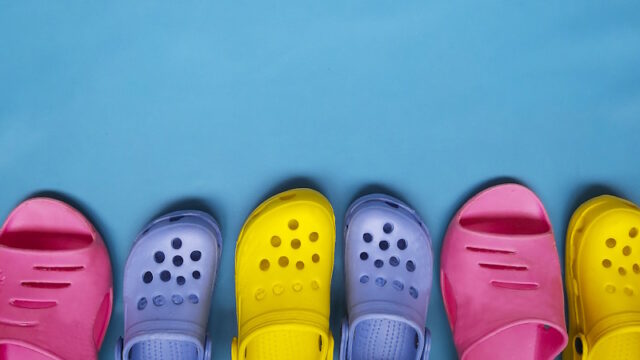
Schools across the US are waging a war against Crocs. According to reports by the New York Post and Today, dozens of schools in at least 20 states have banned students from wearing Crocs to class and punished those who choose to wear them. School administrators say Crocs are hazardous to children and can cause injuries.
Other school officials have banned the popular choice for shoes as students often do not use the strap behind their heels, leading to a growing number of falls and trips due to clogs. Some officials say Crocs are also a source of distraction in classrooms due to fancy and eye-catching collectible charms. To deter pupils from wearing Crocs, schools have taken a variety of steps, from asking them to change to sitting for in-school suspension.
Which States Have Banned Crocs Footwear From Schools?
ALABAMA- Stoney Pritchett, principal of Bessemer City High School in Alabama, told TODAY, “It’s actually a safety hazard. Man, they can twist the knees, twist the ankles, things like that.” He added that Crocs does not provide the necessary mobility support that students need, “In the hallway, kids are moving, things are happening
GEORGIA– Lake City Elementary School in Georgia has made it a requirement for students to wear closed-toe shoes in its dress code and explicitly banned Crocs.
FLORIDA-Several school districts have banned Crocs with an all-caps “NO CROCS” in their dress code.
Schools aren’t the only places putting bans on Crocs, as shoes are also banned on escalators at Disney World and certain medical facilities and labs due to safety concerns. Medical professionals also largely agree with the school’s position on the debate as podiatrist Dr. Priya Parthasarathy explained, “Crocs can easily get caught in equipment, causing the child to fall or injure their foot or rip a toenail off. Things I see in the office on a daily basis,”
Defending Crocs, a company spokesperson told TODAY, “The Classic Clog is a comfortable, casual shoe that is appropriate for everyday wear. We are not, nor do we market ourselves as, a specialty or performance brand.”
Disclaimer
Artificial Intelligence Disclosure & Legal Disclaimer
AI Content Policy.
To provide our readers with timely and comprehensive coverage, South Florida Reporter uses artificial intelligence (AI) to assist in producing certain articles and visual content.
Articles: AI may be used to assist in research, structural drafting, or data analysis. All AI-assisted text is reviewed and edited by our team to ensure accuracy and adherence to our editorial standards.
Images: Any imagery generated or significantly altered by AI is clearly marked with a disclaimer or watermark to distinguish it from traditional photography or editorial illustrations.
General Disclaimer
The information contained in South Florida Reporter is for general information purposes only.
South Florida Reporter assumes no responsibility for errors or omissions in the contents of the Service. In no event shall South Florida Reporter be liable for any special, direct, indirect, consequential, or incidental damages or any damages whatsoever, whether in an action of contract, negligence or other tort, arising out of or in connection with the use of the Service or the contents of the Service.
The Company reserves the right to make additions, deletions, or modifications to the contents of the Service at any time without prior notice. The Company does not warrant that the Service is free of viruses or other harmful components.