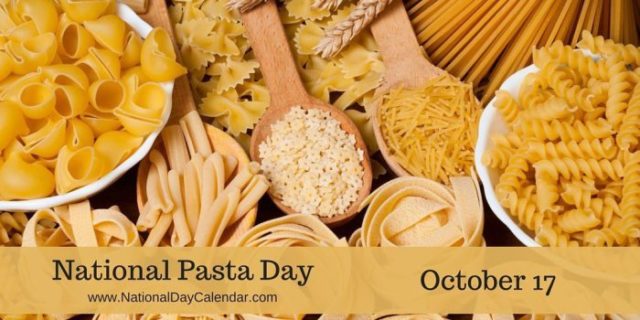
October is National Pasta Month, and October 17 recognizes National Pasta Day.
Pasta lovers celebrate!
Pasta is a type of noodle of traditional Italian cuisine, with the first reference dating to 1154 in Sicily and first attested in English in 1874. Typically, it is made from unleavened dough of durum wheat flour that is mixed with water or eggs and formed into sheets or various shapes. It can then be served fresh or dried to be stored for later use.
The versatility of pasta lends it to sweet and savory dishes. It can be featured as the main dish, a light, fresh side or even the anticipated rich finish as the dessert.
Fresh pasta was originally produced by hand but, today, many varieties of fresh pasta are commercially produced by large-scale machines and the products are widely available in supermarkets.
- Dried and fresh pasta come in a number of shapes and varieties.
- There are 600 specific forms of pasta known variably by over 1300 names having been recently documented.
- In Italy, names of specific pasta shapes or types vary with locale.
- Example: Cavatelli is known by 28 different names depending on the region and town. Learn more about pasta from the National Pasta Association at http://ilovepasta.org/
- The average American consumes 20 lbs. of pasta annually. This makes it the 6th highest food per capita in the country.
- 24% of the global consumption of pasta is by Americans – the largest of any country in the world. Americans consume 6 billion pounds of pasta each year.
- The United States produces 4.4 billion pounds of pasta annually, making it the second largest pasta-producing nation.
- Pasta made its way to the New World through the English, who discovered it while touring Italy. Colonists brought to America the English practice of cooking noodles at least one half hour, then smothering them with cream sauce and cheese.
- On average, Italians eat enough spaghetti-shaped pasta to wind around the world 15,000 times.
- Most Americans (49 percent) eat long pasta by twirling it on their fork only, while others (32 percent) use a spoon to help.
- Based off a 2013 Barilla World Pasta Day survey, Americans’ favorite pasta cuts are spaghetti, penne, and rotini.
- Pasta has always been made with only two simple ingredients: durum wheat and water.
- Researchers found that the majority of people cook their pasta by breaking long noodles in half to fit the pot (55 percent) and adding salt to taste to boiling cooking water (52 percent).
- In terms of which pasta to use, flat pasta is best with cream sauces while tomato sauces will cling to pasta shapes.
Sources:

Disclaimer
Artificial Intelligence Disclosure & Legal Disclaimer
AI Content Policy.
To provide our readers with timely and comprehensive coverage, South Florida Reporter uses artificial intelligence (AI) to assist in producing certain articles and visual content.
Articles: AI may be used to assist in research, structural drafting, or data analysis. All AI-assisted text is reviewed and edited by our team to ensure accuracy and adherence to our editorial standards.
Images: Any imagery generated or significantly altered by AI is clearly marked with a disclaimer or watermark to distinguish it from traditional photography or editorial illustrations.
General Disclaimer
The information contained in South Florida Reporter is for general information purposes only.
South Florida Reporter assumes no responsibility for errors or omissions in the contents of the Service. In no event shall South Florida Reporter be liable for any special, direct, indirect, consequential, or incidental damages or any damages whatsoever, whether in an action of contract, negligence or other tort, arising out of or in connection with the use of the Service or the contents of the Service.
The Company reserves the right to make additions, deletions, or modifications to the contents of the Service at any time without prior notice. The Company does not warrant that the Service is free of viruses or other harmful components.