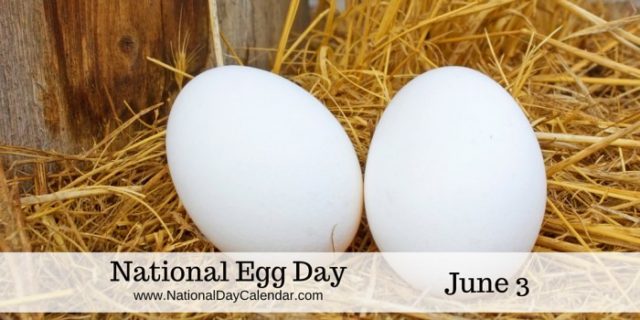
June 3 is an excellent day to practice egg puns and recognize National Egg Day.
One of the most perfect foods, eggs are packed with protein, amino acids and have no carbohydrates or sugar.
As far as versatility goes, there may be more ways to cook an egg than shrimp. From the humble, hard boiled egg to the elegant souffle, eggs Benedict and Florentine.
Even within the good old breakfast standbys like fried eggs, we have options. Over easy. Well done. Sunny side up. Basted. And a side of bacon with that!

Then, of course, it’s portable. Slap it between some toast and off you go.
Eggs are laid by females of many different species, including birds, reptiles, amphibians, and fish, and have been eaten by mankind for thousands of years. Bird and reptile eggs consist of a protective eggshell, albumen (egg white), and vitellus (egg yolk), contained within various thin membranes. Popular choices for egg consumption are chicken, duck, quail, roe, and caviar, but the egg most often consumed by humans is the chicken egg, by a wide margin.
- Egg yolks and whole eggs store significant amounts of protein and choline, and are widely used in cookery. Due to their protein content, the United States Department of Agriculture (USDA) categorizes eggs as Meats within the Food Guide Pyramid. Despite the nutritional value of eggs, there are some potential health issues arising from egg quality, storage, and individual allergies.
- About 240 million laying hens produce some 50 billion eggs each year in the United States. That’s roughly one hen for every man, women and child in the country.
- White shelled eggs are produced by hens with white feathers and ear lobes. Brown shelled eggs are produced by hens with red feathers and red ear lobes. There is no difference in nutrition between white and brown eggs.
- An average hen lays 300 to 325 eggs a year. A hen starts laying eggs at 19 weeks of age.
- The hen must eat 4 pounds of feed to make a dozen eggs.
- While it is customary to throw rice at weddings in many countries, French brides break an egg on the threshold of their new home before stepping in for luck and healthy babies.
- The egg shell may have as many as 17,000 tiny pores over its surface. Through them, the egg can absorb flavors and odors. Storing them in their cartons helps keep them fresh.
- Eggs are placed in their cartons large end up to keep the air cell in place and the yolk centered.
- Eggs age more in one day at room temperature than in one week in the refrigerator
- Eggs can be kept refrigerated in their carton for at least 4 to 5 weeks beyond the pack date.
- Eggs contain the highest quality food protein known. It is second only to mother’s milk for human nutrition.
- The largest single chicken egg ever laid weighed a pound with a double yolk and double shell
- The most expensive egg ever sold was the Faberge “Winter Egg” sold in 1994 for $5.6 million.
Sources:
Disclaimer
Artificial Intelligence Disclosure & Legal Disclaimer
AI Content Policy.
To provide our readers with timely and comprehensive coverage, South Florida Reporter uses artificial intelligence (AI) to assist in producing certain articles and visual content.
Articles: AI may be used to assist in research, structural drafting, or data analysis. All AI-assisted text is reviewed and edited by our team to ensure accuracy and adherence to our editorial standards.
Images: Any imagery generated or significantly altered by AI is clearly marked with a disclaimer or watermark to distinguish it from traditional photography or editorial illustrations.
General Disclaimer
The information contained in South Florida Reporter is for general information purposes only.
South Florida Reporter assumes no responsibility for errors or omissions in the contents of the Service. In no event shall South Florida Reporter be liable for any special, direct, indirect, consequential, or incidental damages or any damages whatsoever, whether in an action of contract, negligence or other tort, arising out of or in connection with the use of the Service or the contents of the Service.
The Company reserves the right to make additions, deletions, or modifications to the contents of the Service at any time without prior notice. The Company does not warrant that the Service is free of viruses or other harmful components.