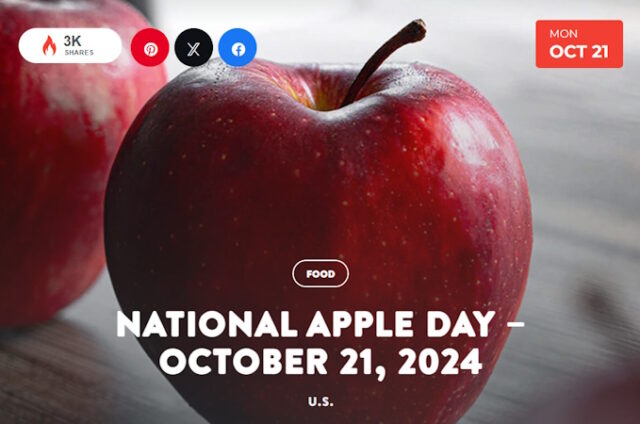
National Apple Day falls on October 21 and is a day dedicated entirely to celebrating all things apple: apple pie, apple sauce, apple crisp… The list goes on and on. This holiday reminds us to appreciate the apple in its myriad forms. On October 21st, pick out your favorite variety, try a new kind of apple (like the super crispy, bright yellow, non-browning Opal® apples), and celebrate with apple lovers worldwide.
- 6500 BC – Archaeologists have found evidence that people have been eating apples since 6,500 B.C.
- 1607 – Colonists arrive at Jamestown with European apple seedlings and begin to plant and harvest apples
- 1625 – The first American apple orchard was planted around 1625 by William Blackstone on Boston’s Beacon Hill.
- 1800s – John Eastman (a.k.a. Johnny Appleseed) travels throughout the Midwest to plant numerous apple trees and educate farmers on proper apple crop care
- 1730 – the first apple nursery was opened in Flushing, New York.
- 1854 – The British Pomological Association began testing new varieties of apples to determine suitability for English farmers.
- 1860s – The old saying “an apple a day keeps the doctor away” is first recorded in the U.S.
- 1875 – The first Red Delicious Apple tree is discovered on Jesse Hiatt’s Iowa farm.
- 1880 – The ‘Ben Davis’ Apple was the reigning king of apples in 1880, due to its ability to handle rough growing conditions and its ability to keep a long time. But it wasn’t considered the best tasting one, and as moving produce from farm to store became easier better tasting was winning out.
- 1930 – The Great Depression called for communities to feed their teachers, therefore the association between education and a gleaming red apple is established in the U.S.
- 1960s – Apple growers in the United States began using controlled atmosphere facilities that maintain the freshness of apples until they are brought to market.
- 1962 – When John Glenn, the first American to orbit Earth, blasted off on his initial space flight, he carried pureed applesauce in squeezable tubes with him.
- 1980s – Red Delicious held its position as the most popular apple in the world well into the 1980s when its popularity began to decline.
- 1980s – The Ginger Gold apple was introduced to the market in the 1980s, it is one of the 15 most popular apples in the world.
- 1987 – The Cameo apple was discovered by chance in an orchard in Oregon in 1987.
- 1990 – The first-ever National Apple Day was on October 21st 1990. The day was founded by the organization Common Ground. It has since been celebrated every year after that on October 21st.
- 2010 -Newly discovered scientific facts made the apple breeding process considerably faster and more accurate.
- 2012 – Medical doctors confirm the health benefits of a red apple, citing its antioxidant-rich skin and its ability to decrease the effects of heart disease.
- 2017 – Worldwide apple production reaches a staggering total of 83,139,326 metric tonnes
- An apple is both delicious and nutritious. With over 7,500 varieties of apples and over 7.5% of the world’s production coming from the USA, apples are widely available.
- Green apples beat the red apples slightly in fiber content. They also have less sugar and carbohydrates. However, red apples tend to taste better when eaten fresh. They’re already naturally sweet and don’t require added sugar. The red apple slightly edges out the green in antioxidants.
- Washington State is one of the biggest producers of apples, and the red delicious constituted 75% of the state’s production. While it’s shrunk to 1/3rd of that amount since it’s still a massive part of the world’s production of apples.
- Apples are part of the rose family, just like pears and plums.
- There are more than 8,000 varieties of apples – the largest variety of fruit to exist.
- Grown exclusively in the United States by FirstFruits Farms in Washington, the Opal® apple is a cross between a Topaz apple and a Golden Delicious apple. It boasts a sweet and tart flavor with a significant crunch—plus, it’s one of the few naturally non-browning and non-GMO apples!
- The life expectancy for an apple tree is about 100 years.
- China is by far the largest apple producer.
- The Apple is popularly known as the supposed forbidden fruit of Eden. But this is not mentioned anywhere in the Bible!
- The Granny Smith apple is named after Maria Ann Smith, this green apple originated in Australia.
- The Honeycrisp – A red apple developed by the Horticultural Research Center at the University of Minnesota.
- The Fuji apple is a hybrid of two American apples, it was developed by researchers in Fujisaki, Japan.
- A medium-sized apple contains 80 calories.
- Pomology is the science of apple-growing
- The fear of apples is known as Malusdomesticaphobia
- There are about 2,500 varieties of apples grown in the United States. About 100 of those are sold commercially. Apples are the second-most valuable fruit grown in the U.S. (oranges being the first).
- Most apples in the world are still picked by hand.
- Americans eat more apples per capita than any other fruit. According to the USDA Economic Research Service, the average American eats about 16 pounds of fresh apples and 28 pounds of processed apples like juice, cider, or sauce, for a total of about 44 pounds per person per year.
- It takes about 36 apples to make one gallon of apple cider.
- After nearly a decade with Red Delicious as the apple darling of the United States, Gala apples are now the nation’s favorite.
- Two pounds of apples make one 9-inch pie.
- Apple juice was one of the earliest prescribed antidepressants.
- A peck of apples weighs 10.5 pounds.
- A bushel of apples weighs 42 pounds and will yield 20-24 quarts of applesauce.
Sources:

Disclaimer
Artificial Intelligence Disclosure & Legal Disclaimer
AI Content Policy.
To provide our readers with timely and comprehensive coverage, South Florida Reporter uses artificial intelligence (AI) to assist in producing certain articles and visual content.
Articles: AI may be used to assist in research, structural drafting, or data analysis. All AI-assisted text is reviewed and edited by our team to ensure accuracy and adherence to our editorial standards.
Images: Any imagery generated or significantly altered by AI is clearly marked with a disclaimer or watermark to distinguish it from traditional photography or editorial illustrations.
General Disclaimer
The information contained in South Florida Reporter is for general information purposes only.
South Florida Reporter assumes no responsibility for errors or omissions in the contents of the Service. In no event shall South Florida Reporter be liable for any special, direct, indirect, consequential, or incidental damages or any damages whatsoever, whether in an action of contract, negligence or other tort, arising out of or in connection with the use of the Service or the contents of the Service.
The Company reserves the right to make additions, deletions, or modifications to the contents of the Service at any time without prior notice. The Company does not warrant that the Service is free of viruses or other harmful components.