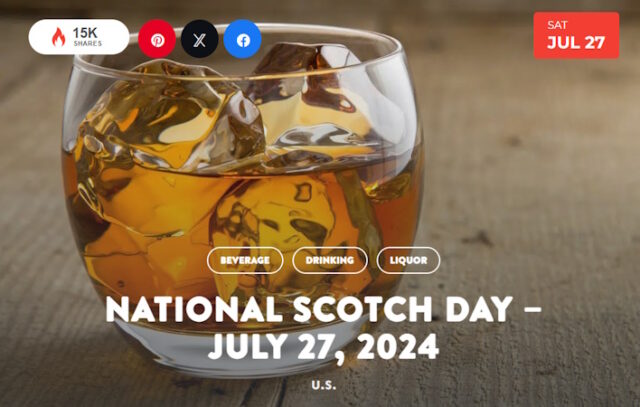
On July 27, we recognize an aged whisky distilled from malted barley. It is National Scotch Day!
This particular whisky first and foremost must be made in Scotland. It must be fermented from malted barley, aged in oak barrels for at least three years and have an ABV of less than 94.8%. While most Scotch is made with barley, water and yeast, other grains can be included, but no fermentation additives, per law.
- 2nd Century BC – The Babylonians of Mesopotamia were likely the first people to distill alcohol in the 2nd millennium BC.
- 12th Century – The origins of Scotch date back to Christian monasteries of the 12th century.
- 13th Century – The earliest records of the distillation of alcohol for the purpose of drinking date back to 13th century Italy, where harder alcohols were distilled from wine.
- 1494 – The earliest written record of distilling whisky is found in the Exchequer Rolls tax records of Scotland. The Exchequer Rolls for 1494 show where malt is sent “To Friar John Cor, by order of the king, to make aqua vitae”, enough to make about 500 bottles.
- 1690 – The earliest reference to a distillery is the famous Ferintosh distillery owned by Duncan Forbes of Culloden.
- 1725 – Scotch was once illegal. The English Malt Tax 1725 shut down much of Scotland’s whisky production and drove many Highlanders to bootlegging. Not that this stopped people from drinking the stuff. Even King George IV called for his Glenlivet by name. Of course, the spirit back then was not quite the same as it is now. Some speculate that Distillers only started aging their whisky much later – as late as the 19th century.
- 1770 – George Washington was the only founding father to commercially operate a distillery. It was one of the biggest distilleries of its time but was unfortunately destroyed by a fire a few years after opening.
- 1800s – John ‘Johnnie’ Walker was a grocer in Kilmarnock, Scotland in the mid-1800s who specialized in blending tea before he decided to start blending whisky.
- 1824 – Glenlivet George Smith takes out the first license to run his distillery.
- There are five distinct categories of Scotch whisky including single malt Scotch, single grain Scotch, blended malt Scotch, blended grain Scotch, and blended Scotch.
- There are mainly two types of Scotch whisky – Single Malt Scotch Whisky and Blended Scotch Whisky.
- Single Malt Scotch Whisky is made from 100% malted barley and distilled at a single distillery.
- Blended Scotch Whisky is made by blending a number of single malts and grain whiskies.
- 90% of all Scotch whisky sold in the market comprises Blended Scotch Whisky.
- The whisky in ‘Scotch Whisky’ is always spelled without an ‘e’.
- In English-speaking countries other than England, Scotch whisky is often referred to as simply ‘Scotch’.
- Your Scotch may be fudging its age a little. Your whisky may claim to be 21 years old, but it may in fact be quite a bit older. Or some of it, at least. The age statement on the label refers to the minimum number of years the spirit has spent maturing in barrels. Most whiskies — even single malts — are a blend of casks from different years.
- Whisky and wood make magic. When it goes into the barrel, Scotch is clear. It gets its color from interacting with the barrel. The older the whisky, generally speaking, the darker.
- Over time, the amount of spirit in the barrel will diminish, at a rate of about 4% per year. The part that evaporates is called the “angel’s share.” After 25 years, more than 40% of the barrel will have gone to the angels.
- France consumes more Scotch than any other country. (The U.K. is the second-biggest consumer and the U.S. the third.)
- More Scotch is sold in France in one month than Cognac in an entire year. Scots can thank the phylloxera epidemic that plagued European vineyards for their whisky’s popularity: the infestation resulted not only in a shortage of wine but a shortage of brandy.
- It’s a common misconception that single malt whisky is the product of one cask. It is the product of a single distillery and may actually come from several casks therein.
- Scotland is home to more than 20 million casks of maturing whisky. That’s almost four for every person living there.
- Whisky in Gaelic reads ‘uisge beathe’, which means ‘water of life’.
- Whisky stored in barrels gradually evaporates at an approximate rate of 2% a year. This is referred to as the famous ‘angels’ share’.
- During World War II, many bourbon distilleries were converted to make fuel and penicillin.
- Some 42 bottles of whisky are exported from Scotland every second.
- Kentucky is home to more barrels of maturing bourbon than people.
- Laid end to end, these casks would stretch about 30,000 kilometers – or about six times the distance between Edinburgh and New York.
- Whiskey is the official state beverage of Alabama.
- Mountain Dew was originally meant to be a whisky chaser.
- Japanese whisky makers rarely trade casks with one another due to how competitive the market is.
- Frank Sinatra was buried with a bottle of Jack Daniel’s.
- Un-aged American whiskey is often called ‘white dog’.
- According to The French Federation of Spirits, whisky accounts for the highest retail sales of any spirit in France at 47.2 percent. This is compared to Cognac which makes up only 0.7 percent of sales.
- John Jameson, the founder of Jameson’s Irish Whisky was Scottish.
- The average measure of whisky contains just 64 calories – fewer than a banana.
- Let the debate end here: Jack Daniel’s is Tennessee whiskey, not bourbon
Sources:

Disclaimer
Artificial Intelligence Disclosure & Legal Disclaimer
AI Content Policy.
To provide our readers with timely and comprehensive coverage, South Florida Reporter uses artificial intelligence (AI) to assist in producing certain articles and visual content.
Articles: AI may be used to assist in research, structural drafting, or data analysis. All AI-assisted text is reviewed and edited by our team to ensure accuracy and adherence to our editorial standards.
Images: Any imagery generated or significantly altered by AI is clearly marked with a disclaimer or watermark to distinguish it from traditional photography or editorial illustrations.
General Disclaimer
The information contained in South Florida Reporter is for general information purposes only.
South Florida Reporter assumes no responsibility for errors or omissions in the contents of the Service. In no event shall South Florida Reporter be liable for any special, direct, indirect, consequential, or incidental damages or any damages whatsoever, whether in an action of contract, negligence or other tort, arising out of or in connection with the use of the Service or the contents of the Service.
The Company reserves the right to make additions, deletions, or modifications to the contents of the Service at any time without prior notice. The Company does not warrant that the Service is free of viruses or other harmful components.