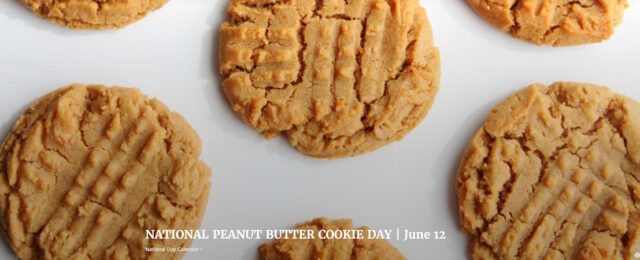
Peanut butter cookie lovers across the United States annually observe National Peanut Butter Cookie Day on June 12.
We don’t know for sure when peanuts were first harvested, but evidence dating back 3,500 years ago indicates that ancient Incans of Peru used peanuts as sacrificial offerings.
- 1700s – Europeans likely brought peanuts to Africa and Asia, and it was eventually Africans who brought peanuts to North America in the 1700s.
- 1884 – The first to patent peanut butter was Marcellus Gilmore Edson in 1884.
- 1895 – John Harvey Kellogg patented a “Process of Preparing Nut Meal” in 1895 and served peanut butter to the patients at his Battle Creek Sanitarium.
- 1902 – The first peanut butter cookie recipe, by Mrs. Rorer’s New Cook Book (1902, Philadelphia, Pennsylvania), suggested a rolled peanut butter ball.
- 1902 – The first commercial cookie in the U.S. was the Animal Cracker, introduced in 1902.
- 1912 – The Oreo, the best-selling cookie of the 20th century, was developed and introduced by the American company Nabisco, in 1912.
- 1913 – the wife of the 28th US President, Woodrow Wilson, published a list of her cookie recipes, which generously included a recipe for Peanut Cookies that, of course, used peanut butter.
- 1916 – George Washington Carver compiled 105 peanut recipes from various cookbooks, agricultural bulletins, and other sources. Carver put together a Research Bulletin called How to Grow the Peanut and 105 Ways of Preparing it for Human Consumption.
- Included in this Research Bulletin were three recipes for peanut cookies calling for crushed or chopped peanuts as one of its ingredients.
- 1920 – Despite being known for years, peanut butter does not become commercially available until 1920.
- 1920s – It was in the early 1920s that peanut butter was found listed as an ingredient in cookies.
- 1922 – Joseph Rosefield develops a process to prevent peanut oil from separating from the solids.
- 1932 – “The Schenectady Gazette” is the first to run a recipe for peanut butter cookies that involve the classic fork-press decoration on top! It said to “shape [the dough] into balls and after placing them on the cookie sheet, press each one down with a fork, first one way and then the other, so they look like squares on waffles”
- 1936 – The first time that these fork marks were widely instructed to be placed on the cookie tops was in a recipe from a 1936 Pillsbury cookbook.
- 1992 – Studies in 1992 show that Americans consume 3.36 pounds of peanut butter per year — a total of 857 million pounds!
- The U.S. leads the world as the biggest cookie bakers and eaters, spending more than $550 million annually on Oreos alone.
- The U.S. has a National Cookie Cutter Historical Museum located within the Joplin Museum Complex in Joplin, Missouri.
- Because bread has too many crumbs for a zero-gravity environment, astronauts who love peanut butter enjoy it on a tortilla!
- ‘Tagalongs’ or ‘Peanut Butter Patties’ are usually the runner-up or third-bestselling cookie of the Girl Scouts.
- $800 million is spent yearly in America just on peanut butter!
- According to one survey, it’s estimated that ¾ of the houses in America have at least one jar of peanut butter in their home.
- According to Skippy Peanut Butter, over 30 celebrities (including Jerry Seinfeld and Madonna) are part of their Adult Peanut Butter Lovers Fan Club.
Sources:

Disclaimer
Artificial Intelligence Disclosure & Legal Disclaimer
AI Content Policy.
To provide our readers with timely and comprehensive coverage, South Florida Reporter uses artificial intelligence (AI) to assist in producing certain articles and visual content.
Articles: AI may be used to assist in research, structural drafting, or data analysis. All AI-assisted text is reviewed and edited by our team to ensure accuracy and adherence to our editorial standards.
Images: Any imagery generated or significantly altered by AI is clearly marked with a disclaimer or watermark to distinguish it from traditional photography or editorial illustrations.
General Disclaimer
The information contained in South Florida Reporter is for general information purposes only.
South Florida Reporter assumes no responsibility for errors or omissions in the contents of the Service. In no event shall South Florida Reporter be liable for any special, direct, indirect, consequential, or incidental damages or any damages whatsoever, whether in an action of contract, negligence or other tort, arising out of or in connection with the use of the Service or the contents of the Service.
The Company reserves the right to make additions, deletions, or modifications to the contents of the Service at any time without prior notice. The Company does not warrant that the Service is free of viruses or other harmful components.