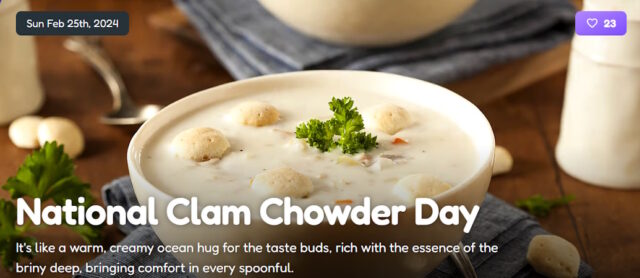
Each year on February 25th, people across the nation have a bowl and spoon ready to be filled with clam chowder as they prepare to participate in National Clam Chowder Day.
- 1751 – The first known chowder recipe was published in the Boston Evening Post in 1751. It was a layered dish made using fish, salt pork, onions, hardtack, spices, pepper, water, red wine and herbs.
- 1795 – Chowder dates back as early as 1795 when it was originally made as water-based fish soup and various thicknesses featuring onions, potatoes, and carrots.
- In 1832, newspaperwoman, novelist, and ardent advocate of women’s rights Lydia Maria Child (1802-1880) published her cookbook, The American Frugal Housewife. She described the standard layering technique of chowder-making and suggested additional ingredients such as lemons, beer, tomato catsup, and the first written directions to add clams.
- In 1836, clam chowder became a staple for sailors, as it was another way to make a constant fish diet palatable. Most were then creamy white soup, as a diary, which became a more popular addition to the soup in cooler regions where milk animals flourished.
- 1849 – Clam chowder is sometimes served in sourdough bread bowls, especially in San Francisco, where sourdough bread is popular with tourists and has been considered a signature dish since 1849.
- 1884 – In the Southern and Midwestern United States, fresh sweet corn (maize) often replaces the clams in chowder. Recipes for corn chowder date back to at least 1884, when a corn chowder recipe was published in the Boston Cook Book, authored by Mary Lincoln of the Boston Cooking School.
- 1890 – In the magazine American Notes and Queries, it was said that the dish was of French origin. Among French settlers in Canada, it was a custom to stew clams and fish laid in courses with bacon, sea biscuits, and other ingredients in a bucket called a “chaudière,” it thus came to be invented.
- In the 1890s, chowder was called “Fulton Fish Market clam chowder” and “New York City clam chowder.” Manhattan clam chowder was referenced in Victor Hirtzler’s “Hotel St. Francis Cookbook.”
- 1939 – a bill was introduced in the Maine state legislature that almost made the use of tomatoes in clam chowder against the law.
- A clam chowder, in its simplest form, is a soup or stew containing clams or fish. The most common type of chowder includes milk or cream and potatoes, though the Manhattan clam chowder has tomatoes.
- The origin of the word “chowder” is up for a little bit of debate. The French word for cauldron is “chaudiere.” The English word “jowter” means fish peddler. Both are on the hook for possible origins.
- In chowder, along with the clams, it is common to find diced potatoes, onions (often sautéed with pork or bacon drippings), and celery.
- Fish chowders were the forerunners of clam chowder. The chowders originally made by the early settlers differed from other fish soups because they used salt pork and ship’s biscuits.
- Clams and oysters were consumed in such quantities along the Atlantic coast by the American Indians that, in some favorable gathering places, empty shells were piled into mounds ten feet high.
- New England clam chowder is usually accompanied by oyster crackers
- Clam chowder was often served in restaurants on Fridays to provide a seafood option for those who abstain from meat every Friday, which used to be a requirement for Catholics before liturgical changes in Vatican II.
- New England clam chowder shares the number one spot for the most-served soups in the United States with chicken noodles.
- There are more than 15,000 species of clams, but only 150 are edible.
- in the Maritime Provinces, Canadian chowder is thinner and more seafood-forward than its creamier American counterparts.
- Manhattan clam chowder contains tomatoes. New England clam chowder enthusiasts vehemently oppose this practice.
- Following is a list of the basic clam chowder variants:
- New England clam chowder
- Manhattan clam chowder
- Rhode Island clam chowder
- Delaware clam chowder
- New Jersey clam chowder
- Hatteras clam chowder
- Minorcan clam chowder
- Long Island clam chowder
- Puget Sound clam chowder
Sources:

Disclaimer
Artificial Intelligence Disclosure & Legal Disclaimer
AI Content Policy.
To provide our readers with timely and comprehensive coverage, South Florida Reporter uses artificial intelligence (AI) to assist in producing certain articles and visual content.
Articles: AI may be used to assist in research, structural drafting, or data analysis. All AI-assisted text is reviewed and edited by our team to ensure accuracy and adherence to our editorial standards.
Images: Any imagery generated or significantly altered by AI is clearly marked with a disclaimer or watermark to distinguish it from traditional photography or editorial illustrations.
General Disclaimer
The information contained in South Florida Reporter is for general information purposes only.
South Florida Reporter assumes no responsibility for errors or omissions in the contents of the Service. In no event shall South Florida Reporter be liable for any special, direct, indirect, consequential, or incidental damages or any damages whatsoever, whether in an action of contract, negligence or other tort, arising out of or in connection with the use of the Service or the contents of the Service.
The Company reserves the right to make additions, deletions, or modifications to the contents of the Service at any time without prior notice. The Company does not warrant that the Service is free of viruses or other harmful components.