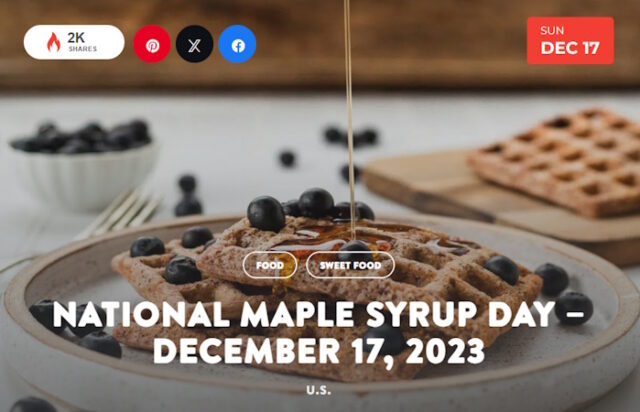
National Maple Syrup Day is on December 17! This viscous yet delicious condiment that is just as versatile as it is tasty; people enjoy it drizzled over everything: from pancakes, to eggs, to salads, to barbecue, this sugary substance has more potential than some give it credit for. On December 17, pour away!
- Maple syrup was first collected, processed, and used by the indigenous peoples of North America.
- The practice was then adopted by the European settlers who gradually refined production methods.
- 1850s – The introduction of flat sheet pans in the sap boiling process allows for faster evaporation.
- 1940s – Food rations during WWII give cause for northeasterners to substitute their normal sweeteners for maple syrup and maple sugar.
- 1970s – In the 1970s further refinements in syrup processing were made with technological improvements.
- 2000s – First feared as an instance of chemical warfare, the mysterious appearance of the smell of maple syrup in the streets of New York City is found to originate from a nearby food processing factory in New Jersey.
- 2012 – 6 millions pounds of maple syrup was stolen from the syrup stockpile held by the Federation of Quebec Maple Syrup Producers. While authorities managed to track down dozens of people responsible for the theft, about one-third of their take is still to be recovered.
- A maple syrup production farm is called a sugarbush or a sugarwood.
- Sap is boiled in a sugar house which is also known as a sugar shack, sugar shanty or a cabane à sucre.
- Up until the 1930s, the United States led in maple syrup production, now Canada is the world’s largest maple syrup producer.
- The Canadian province of Quebec is by far the largest producer, responsible for about three-quarters of the world’s output; Canadian exports of maple syrup exceed 270 million USD per year.
- According to the New York Times, Canada is responsible for roughly 70% of the world’s total supply of maple syrup. Fitting for the country that sports the tree’s leaf on its flag!
- Vermont is the largest producer in the United States, generating about 5.5 percent of the global supply.
- It takes 40 gallons of sap to make one gallon of maple syrup.
- It takes one gallon of maple syrup to produce eight pounds of maple candy or sugar
- A gallon of maple syrup weighs 11 pounds
- There are three shades of Grade A Amber – light, medium, and dark.
- The sugar content of sap averages 2.5 percent; sugar content of maple syrup is at least 66 percent or more
- Each tap will yield an average of 10 gallons of sap per season, producing about one quart of syrup.
- The maple season may last eight to 10 weeks, but sap flow is heaviest for about 10-20 days in the early spring.
- Canadians make a candy called tire d’érable (also known as Maple Syrup Taffy) by pouring maple syrup on snow, then rolling it onto sticks. – Source
- Maple syrup bottles have little handles on them because they originally came in 5lb containers that needed handles to hold, so when shrinking the bottle the handle was kept on because people associated the handle with that product. – Source
- Maple syrup has more calcium than milk. – Source
- Because maple syrup doesn’t always look good on camera, many food advertisers replace it with motor oil in commercials. – Source
- Due to food rationing during WWII, people in the U.S. were encouraged to stretch their sugar rations by sweetening foods with maple syrup and maple sugar, and recipe books were printed at that time to help housewives employ this alternative source to cane sugar. – Source
- IHOP (the International House of Pancakes) has only 1 location out of 1400 that serves actual maple syrup. – Source
- The syrup you have in the pantry probably doesn’t contain much maple sap. Cheaper, maple-flavored syrups are made with a negligible amount of maple sap—here’s how to tell if your syrup is the real thing. Treat yourself to a jar of pure maple syrup.
- Maple syrup is the secret ingredient in a master cleanse. Celebrities including Beyoncé attribute maple syrup to their weight loss and detox regime, which consist of consuming only maple syrup, lemon juice, cayenne pepper and water for 10 days straight.
- Maple syrup is packed with nutrients and antioxidants. The syrup is filled with antioxidants as well as healthy minerals like zinc, magnesium, calcium and potassium
Sources:

Disclaimer
Artificial Intelligence Disclosure & Legal Disclaimer
AI Content Policy.
To provide our readers with timely and comprehensive coverage, South Florida Reporter uses artificial intelligence (AI) to assist in producing certain articles and visual content.
Articles: AI may be used to assist in research, structural drafting, or data analysis. All AI-assisted text is reviewed and edited by our team to ensure accuracy and adherence to our editorial standards.
Images: Any imagery generated or significantly altered by AI is clearly marked with a disclaimer or watermark to distinguish it from traditional photography or editorial illustrations.
General Disclaimer
The information contained in South Florida Reporter is for general information purposes only.
South Florida Reporter assumes no responsibility for errors or omissions in the contents of the Service. In no event shall South Florida Reporter be liable for any special, direct, indirect, consequential, or incidental damages or any damages whatsoever, whether in an action of contract, negligence or other tort, arising out of or in connection with the use of the Service or the contents of the Service.
The Company reserves the right to make additions, deletions, or modifications to the contents of the Service at any time without prior notice. The Company does not warrant that the Service is free of viruses or other harmful components.