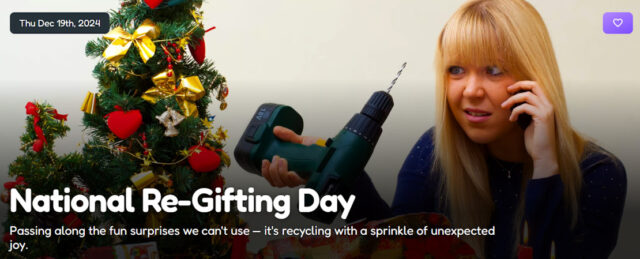
Each year on the Thursday before Christmas people across the United States participate in National Re-gifting Day. This day was chosen in honor of office parties and the unique Christmas gift exchange that they do.
- 1828 – White Elephant gift exchanges, where the concept of ‘stealing’ or swapping fun or humorous gifts, enter the Western lexicon.
- 1995 – The “Seinfeld” episode, ‘The Label Maker,’ grants the act of re-gifting legitimacy and even fosters broad cultural currency.
- 2008 – In October, the state of Colorado declares National Re-Gifting Day a national holiday.
- 2008 – In December the first National Re-Gifting Day is celebrated.
- 2019 – an event in Melbourne, Australia, set a unique record. Hundreds of participants exchanged re-gifted items in a massive swap meet to promote sustainability and generosity. This event celebrated both the quirky fun of re-gifting and its practical benefits in reducing waste.
- National Re-Gifting Day originally started off as an office holiday during the holiday season where co-workers would often re-gift gifts that they received and didn’t really want.
- As a method of recycling, approximately 14%, of those surveyed, believe that regifting is becoming more popular, for that reason alone.
- About 80% of consumers report wrapping their own presents.
- The average shopper buys presents for approximately eight recipients each year.
- People are more likely to buy gifts for pets rather than for friends.
- The average holiday shopping budget is $708.03.
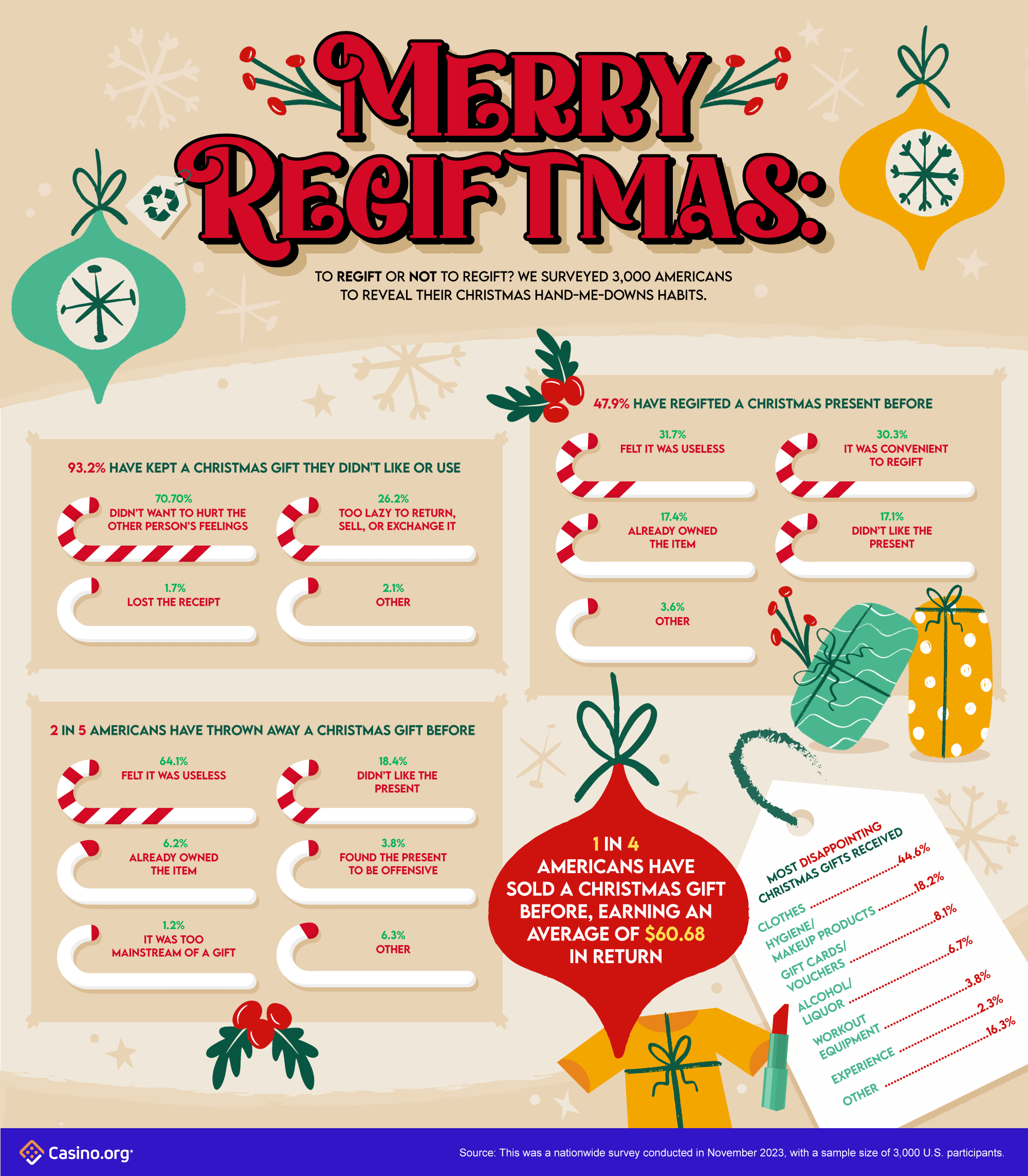
- 47.9% confess to the act of regifting a Christmas present
- 2 in 5 Americans have thrown away a Christmas gift before
- 1 in 4 Americans have sold a Christmas present before, earning an average of $60.68 in profit
- Clothing items are the #1 most disappointing Christmas gift Americans have received
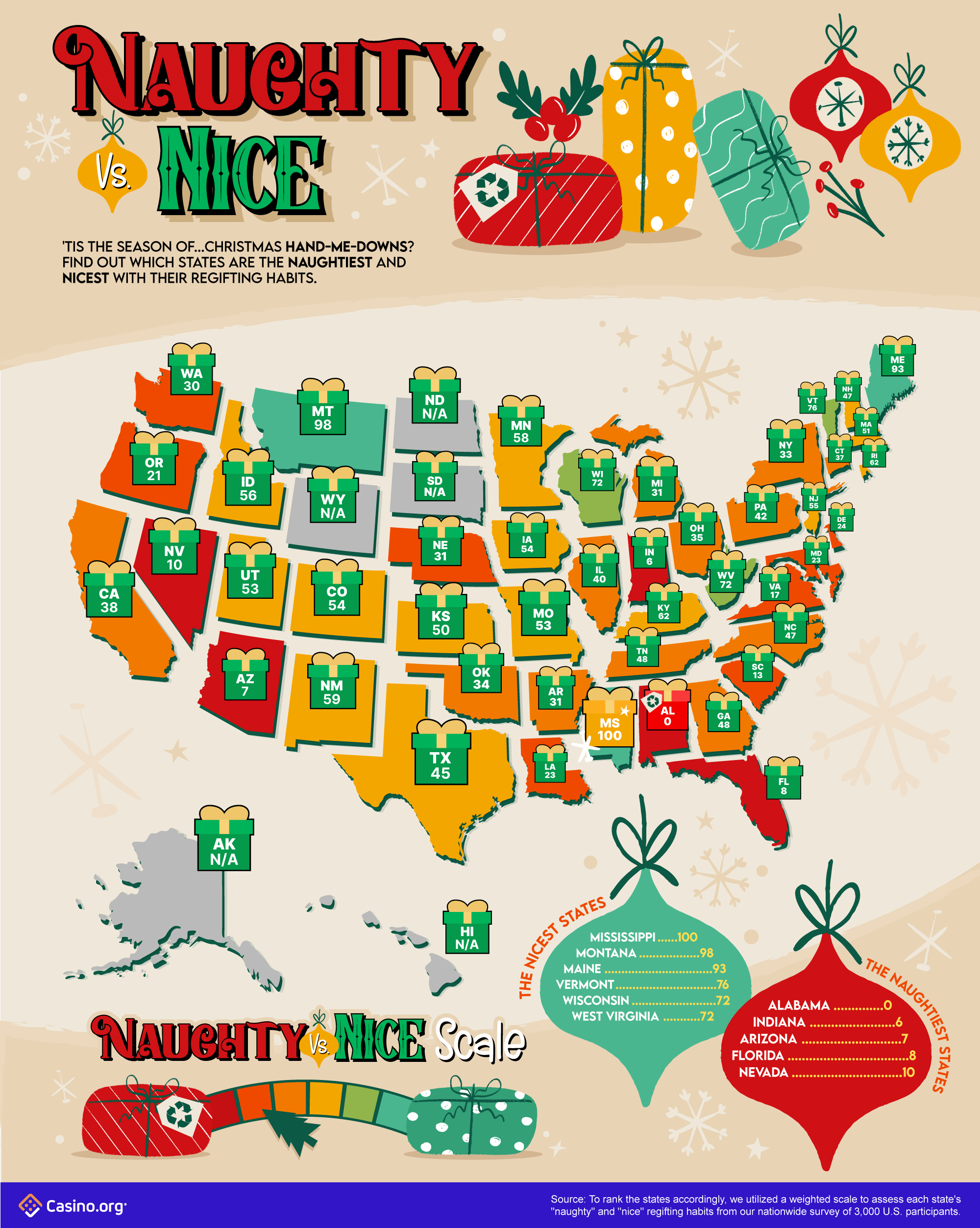
- Alabama ranked #1 on Santa’s Naughty List, while Mississippi ranked #1 on Santa’s Nice List
- 93.2% play nice as they’ve kept a Christmas present they disliked or didn’t use.
- 70.0% of these respondents do so to avoid the ‘Grinch’ attitude by sparing feelings.
- 26.2% admit to holiday laziness in not returning, selling, or exchanging gifts; while 1.2% simply lost their receipt.
- 31.7% of the gift receivers deem their presents useless.
- 30.3% find regifting as a convenient solution
- The gift is brand new and in its original packaging.
- Be careful not to re-gift something to the original giver.
- Re-wrap all gifts and remove any tags that may suggest you didn’t do the shopping for the re-gifted item.
- Be prepared to answer questions about the gift. Questions such as “Where did you find this? I’ve been looking everywhere for one!” may give up the secret if you aren’t able to give a convincing answer. (It should really start feeling deceitful, now.)
- Socks, alcohol, and scented candles are known to be the most widely accepted items to be re-gifted to other people.
- Regifting gifts:
- Unused handmade gifts – Knitted scarves, sweaters, and blankets sometimes become cherished gifts. Leather or woodcraft items also make excellent gifts.
- Books – Some people cherish used books much more than brand-new copies.
- Plants – If you’re not a plant person and received a plant, giving the plant to a plant person makes two species happy.
- Duplicate high-end items – It happens. You receive two toasters, two rice cookers, and three sets of mixing bowls for your shower or house warming party. Well, you can return them or you can give them to someone you know will use them. Regift to another new homeowner, college student, or someone you know has been wanting that pressure cooker.
- Sets of things – For example, wine glasses, coffee mugs, flower pots, and salt and pepper grinders. All of these are acceptable gifts under any circumstance. Chances are, you don’t have the receipt for these, and all of them will be enjoyed by the right person.
- Several ways to make regifting generally approved are:
- Pair the item with a gift card.
- Create a culture in your family where regifting is acceptable. Agree that the gifts must be handmade, repurposed, or regifted.
- Pair the gift with baked goods.
- In Chinese culture, re-gifting is often taboo, while in Indian culture, it’s more acceptable and seen as a way to celebrate relationships.
Sources:

Disclaimer
Artificial Intelligence Disclosure & Legal Disclaimer
AI Content Policy.
To provide our readers with timely and comprehensive coverage, South Florida Reporter uses artificial intelligence (AI) to assist in producing certain articles and visual content.
Articles: AI may be used to assist in research, structural drafting, or data analysis. All AI-assisted text is reviewed and edited by our team to ensure accuracy and adherence to our editorial standards.
Images: Any imagery generated or significantly altered by AI is clearly marked with a disclaimer or watermark to distinguish it from traditional photography or editorial illustrations.
General Disclaimer
The information contained in South Florida Reporter is for general information purposes only.
South Florida Reporter assumes no responsibility for errors or omissions in the contents of the Service. In no event shall South Florida Reporter be liable for any special, direct, indirect, consequential, or incidental damages or any damages whatsoever, whether in an action of contract, negligence or other tort, arising out of or in connection with the use of the Service or the contents of the Service.
The Company reserves the right to make additions, deletions, or modifications to the contents of the Service at any time without prior notice. The Company does not warrant that the Service is free of viruses or other harmful components.