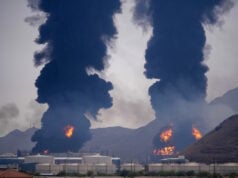
WASHINGTON, D.C. — In a dramatic and controversial expansion of his administration’s “War on Drugs,” President Donald Trump announced this week that the United States is preparing to launch military “land strikes” against drug-trafficking operations in Latin American countries.
The comments, made to reporters at the White House on Friday, December 12, 2025, follow months of U.S. military attacks targeting alleged drug-smuggling vessels in the Caribbean and Pacific Ocean. Trump claimed that the maritime interdiction campaign has been highly successful, but he is now shifting focus.
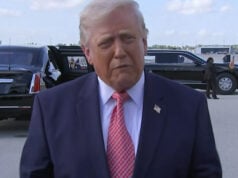
“We knocked out 96 per cent of the drugs coming in by water, and now we’re starting by land, and by land is a lot easier, and that’s going to start happening,” the President said, without providing immediate details on the timing or specific targets of the potential strikes. He added that the targets are “people that are bringing in drugs to our country” and that the military action would not necessarily be restricted to one nation.
While much of the administration’s recent military buildup in the region has been directed at Venezuela, which the U.S. has accused of “narco-terrorism,” the President signaled a broader scope. In recent days, the President has mentioned that countries like Mexico and Colombia—major producers and transit points for illicit drugs like cocaine and fentanyl—are also vulnerable to attack.

This expansion of the counter-narcotics mission from maritime interdiction to land-based military operations represents a significant escalation, raising immediate concerns among foreign policy experts and members of Congress. Critics argue that such actions, taken without the authorization of the host countries or explicit congressional approval for a wider war, could violate international law and lead to a dangerous regional conflict.
The administration’s existing campaign, “Operation Southern Spear,” has already resulted in numerous deadly strikes on boats, with the legality of these actions facing bipartisan scrutiny on Capitol Hill. Defense Secretary Pete Hegseth, who has defended the maritime strikes as lawful, has been a key figure in the administration’s aggressive posture. The focus on land operations suggests the administration is determined to press forward despite the mounting legal and diplomatic challenges.
Venezuelan President Nicolas Maduro has denounced the U.S. military actions as “naval piracy” and an illegal attempt at regime change, vowing that the Venezuelan working class would mount a “general insurrectionary strike” if the nation were to face a foreign attack. The escalating tensions follow the recent seizure of a Venezuelan oil tanker by U.S. forces, further heightening the risk of direct conflict in the region.
The White House is framing the military action as a necessary defense against a humanitarian crisis, with the President asserting that the U.S. drug overdose epidemic is “like a war that would be unparalleled” if the deaths were counted like combat fatalities. However, the move is widely seen by analysts as a high-stakes gamble that could destabilize the region and draw the United States into open hostilities.
Sources and Links
- The Guardian: Trump threatens strikes on any country he claims makes drugs for US
- The Straits Times: Trump says US will be ‘starting’ land strikes on drug operations in Latin America
- KSL.com: Trump eyes anti-drug operations in Mexico, Colombia as Venezuela looms
- CNA: Trump again says land strikes on Venezuela drug shipments coming soon
Disclaimer
Artificial Intelligence Disclosure & Legal Disclaimer
AI Content Policy.
To provide our readers with timely and comprehensive coverage, South Florida Reporter uses artificial intelligence (AI) to assist in producing certain articles and visual content.
Articles: AI may be used to assist in research, structural drafting, or data analysis. All AI-assisted text is reviewed and edited by our team to ensure accuracy and adherence to our editorial standards.
Images: Any imagery generated or significantly altered by AI is clearly marked with a disclaimer or watermark to distinguish it from traditional photography or editorial illustrations.
General Disclaimer
The information contained in South Florida Reporter is for general information purposes only.
South Florida Reporter assumes no responsibility for errors or omissions in the contents of the Service. In no event shall South Florida Reporter be liable for any special, direct, indirect, consequential, or incidental damages or any damages whatsoever, whether in an action of contract, negligence or other tort, arising out of or in connection with the use of the Service or the contents of the Service.
The Company reserves the right to make additions, deletions, or modifications to the contents of the Service at any time without prior notice. The Company does not warrant that the Service is free of viruses or other harmful components.