WASHINGTON D.C.— The Trump administration has officially invoked national security concerns to defend the expedited construction of the controversial White House ballroom, arguing in a federal court filing Monday that halting the project would compromise the safety and security of the President. The administration’s position came in response to a lawsuit filed last Friday by the National Trust for Historic Preservation, which is seeking a temporary restraining order to pause the work until it undergoes legally mandated federal reviews and receives Congressional approval.
In the filing, the administration included a declaration from a U.S. Secret Service deputy director asserting that continued work on the site, where the historic East Wing once stood, is essential to meet the agency’s “safety and security requirements.” The document stated that even a temporary halt to construction would “consequently hamper” the Secret Service’s ability to fulfill its protective mission, though it provided scant public detail on the specific security needs. The administration has offered to share classified information with the federal judge presiding over the case to elaborate on its national security claim without disclosing details to the plaintiffs or the public.
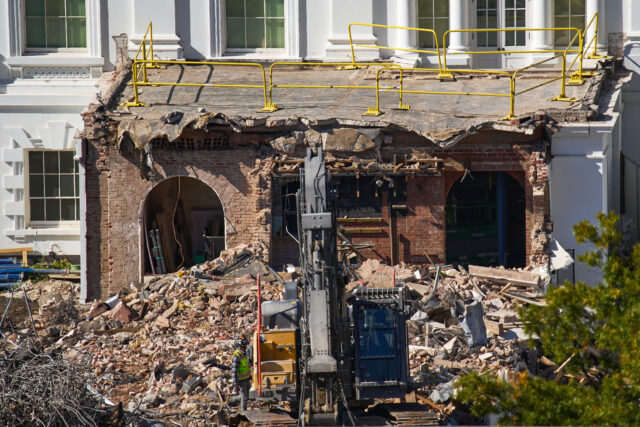
The National Trust for Historic Preservation, a privately funded group, argues that the President has unlawfully fast-tracked the $300 million project, which will create a 90,000-square-foot ballroom—nearly twice the size of the original White House before the East Wing. The lawsuit contends that the demolition of the East Wing in October and the ongoing construction violate federal laws, including those requiring comprehensive design reviews, environmental assessments, and public comments before such a monumental addition is made to a public property of national significance.
The administration’s defense also asserts that the President possesses the legal authority to modify the White House, referencing the long history of renovations and additions to the Executive Mansion. Legal experts and critics have questioned the administration’s expansive use of the national security justification to bypass standard oversight for a project that has drawn public criticism for its scale and funding. The funds for the ballroom are being raised privately, reportedly from wealthy donors and large corporations, including those with federal contracts. Work on the foundations is scheduled to begin in January, with above-ground construction anticipated to start in April 2026. A hearing on the National Trust’s request for an injunction is set for Tuesday.

Sources and Links
- Associated Press: Trump administration says White House ballroom construction is a matter of national security
- * Trump sued by preservationists seeking reviews and congressional approval for ballroom project
- The Guardian: Trump sued by preservation group over $300m White House ballroom project
- PBS NewsHour: Preservationists sue Trump for ballroom project reviews and congressional approval
Disclaimer
Artificial Intelligence Disclosure & Legal Disclaimer
AI Content Policy.
To provide our readers with timely and comprehensive coverage, South Florida Reporter uses artificial intelligence (AI) to assist in producing certain articles and visual content.
Articles: AI may be used to assist in research, structural drafting, or data analysis. All AI-assisted text is reviewed and edited by our team to ensure accuracy and adherence to our editorial standards.
Images: Any imagery generated or significantly altered by AI is clearly marked with a disclaimer or watermark to distinguish it from traditional photography or editorial illustrations.
General Disclaimer
The information contained in South Florida Reporter is for general information purposes only.
South Florida Reporter assumes no responsibility for errors or omissions in the contents of the Service. In no event shall South Florida Reporter be liable for any special, direct, indirect, consequential, or incidental damages or any damages whatsoever, whether in an action of contract, negligence or other tort, arising out of or in connection with the use of the Service or the contents of the Service.
The Company reserves the right to make additions, deletions, or modifications to the contents of the Service at any time without prior notice. The Company does not warrant that the Service is free of viruses or other harmful components.